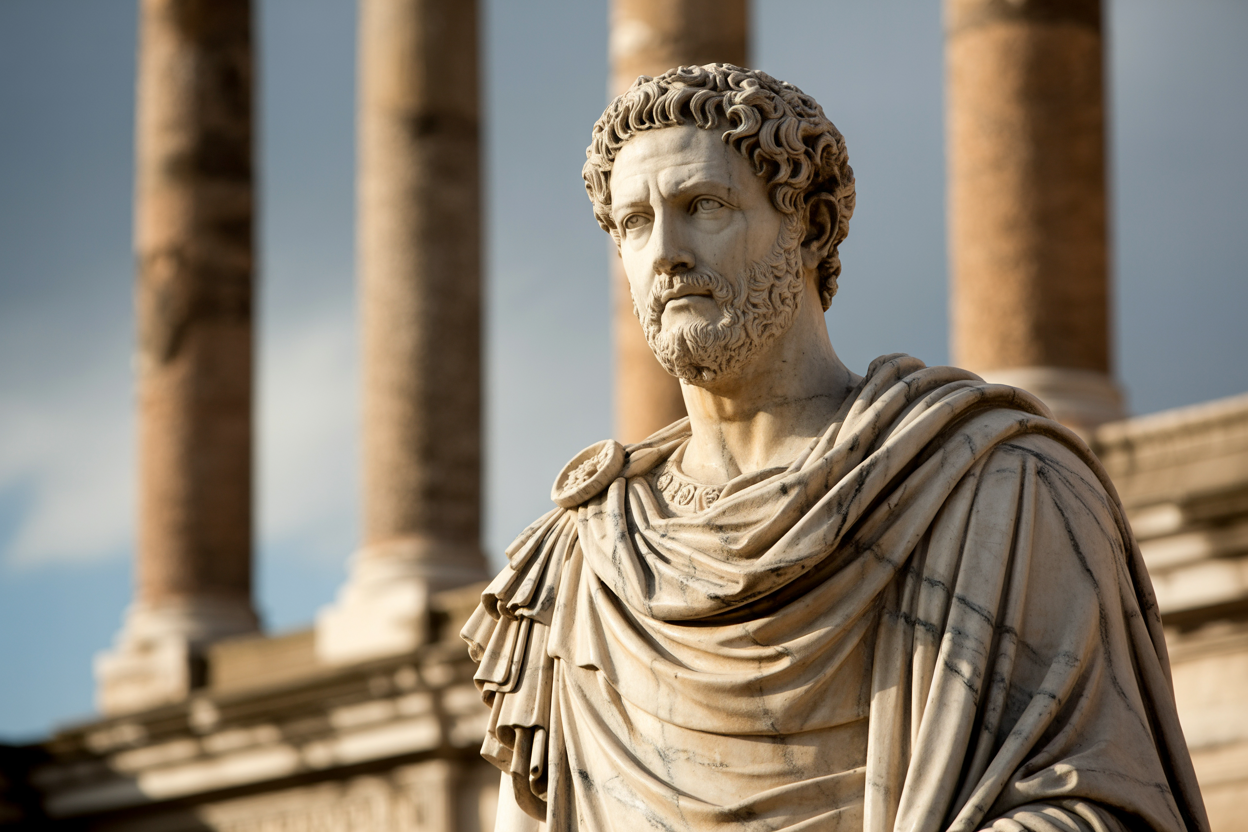
Marcus Aurelius ruled the Roman Empire during one of its most turbulent periods — plagues, wars, betrayals, and economic instability tested him daily for nearly two decades. Yet he was never broken. His private journal, now known as Meditations, reveals a disciplined psychological framework that kept him grounded as everything around him fell apart.
These aren’t motivational slogans. They’re battle-tested mental strategies from a man who faced more pressure in a single week than most people encounter in a lifetime. Here are seven rules drawn from his Stoic psychology that build real mental strength when the world turns chaotic.
1. Control the Controllable and Release Everything Else
The foundation of Aurelius’ entire psychological system rests on one distinction: what is up to you and what is not. Your opinions, your effort, your responses — these belong to you. Other people’s behavior, market conditions, political outcomes, and natural disasters do not. Aurelius wrote that most of our suffering comes from confusing these two categories.
We exhaust ourselves trying to control things that were never ours to manage in the first place. Mental strength begins the moment you stop wasting energy on outcomes you cannot influence and redirect that energy toward the only thing you actually command — your own mind and actions. This single shift eliminates a massive percentage of daily anxiety and frustration.
2. Train Your Perception to See Events as Neutral
Aurelius practiced a technique that modern cognitive behavioral therapy would later rediscover: reframing. He argued that events themselves carry no inherent emotional charge. A job loss, a market crash, or a personal setback is just an event — it’s your judgment about that event that creates suffering. He trained himself to strip away the emotional narrative and see situations as raw data.
This doesn’t mean suppressing emotions or pretending pain doesn’t exist. It means refusing to let your first emotional reaction become your permanent interpretation. When you catch yourself catastrophizing, pause and ask what the situation actually is without the story you’ve attached to it. The chaos doesn’t change, but your relationship to it transforms completely.
3. Practice Voluntary Discomfort Before Life Forces It on You
Aurelius didn’t wait for hardship to arrive — he prepared for it. The Stoics practiced what they called praemeditatio malorum, a deliberate rehearsal of worst-case scenarios. This wasn’t pessimism. It was inoculation. By mentally walking through loss, failure, and difficulty in advance, Aurelius reduced the shock when those things actually occurred.
He also embraced physical simplicity — sleeping on hard surfaces, eating plain food, and stripping away luxury — not out of self-punishment but to prove to himself that comfort wasn’t a requirement for functioning. People who only know ease crumble at the first sign of difficulty. Those who’ve practiced discomfort already know they can survive it, which makes them psychologically resilient when absolute chaos hits.
4. Use the Morning to Fortify Your Mind Before the World Attacks It
Aurelius began each day with a deliberate mental exercise. He would anticipate the difficult people, frustrating situations, and unexpected obstacles he would likely face. He told himself that he would encounter liars, ungrateful people, and those acting out of ignorance — and that none of this should surprise or destabilize him.
This morning’s preparation acted as psychological armor. Most people start their day reactively, scrolling through news or social media that immediately hijacks their emotional state. Aurelius did the opposite. He took control of his mental frame before anyone else could set it for him. Even ten minutes of intentional mental preparation each morning creates a buffer between you and the chaos that follows.
5. Measure Your Life by Your Actions, Not by Your Circumstances
One of Aurelius’ most powerful psychological habits was judging himself solely by what he did — not by what happened to him. External results are partly driven by luck, timing, and forces beyond individual control. But effort, integrity, and consistency belong entirely to the person who chooses them.
Aurelius argued that a person who acts with virtue in terrible circumstances is worth far more than someone who coasts through easy times. This framework is liberating because it removes the need for external validation. You don’t need the promotion, the applause, or the market to cooperate to feel good about yourself. You need to know that you showed up and did the work with full effort and honest intention. In a chaotic world, this is the only scoreboard that doesn’t lie.
6. Accept Impermanence as a Source of Strength, Not Fear
Aurelius thought constantly about death — his own, his loved ones’, even the death of empires. This wasn’t morbid. It was clarifying. By accepting that everything is temporary, he freed himself from the desperate clinging that makes people fragile. When you understand that your career, your health, your relationships, and life are all finite, you stop taking them for granted and start engaging with them more fully.
Fear of loss creates paralysis. Acceptance of impermanence creates urgency and presence. Aurelius used this awareness to cut through trivial concerns and focus on what actually mattered. People who refuse to think about endings live in a state of low-grade denial that shatters when reality forces the conversation. Those who’ve already made peace with impermanence are free to act boldly.
7. Return to Your Principles When Emotions Try to Steer You
Aurelius treated his core principles as an anchor. When emotions surged — anger at a betrayal, fear during a crisis, frustration with incompetence — he didn’t follow the feeling. He returned to his values and asked what the situation required from a rational, principled person. This is the most brutal rule because emotions feel urgent and accurate in the moment. But Aurelius understood that feelings are temporary signals, not reliable guides for action.
He built a practice of inserting a pause between stimulus and response, using that gap to consult his principles rather than his impulses. Over time, this practice becomes automatic. You stop being a person who reacts and become a person who responds — and that distinction is the difference between someone who survives chaos and someone who is consumed by it.
Conclusion
The world Marcus Aurelius navigated was violent, unpredictable, and unforgiving. The world we navigate today is chaotic in different ways — economic uncertainty, technological disruption, information overload, and social fragmentation. But the psychology required to stay strong through it hasn’t changed in two thousand years.
These seven rules aren’t about positive thinking or pretending everything is fine. They’re about building an internal operating system that functions regardless of what’s happening externally. That’s what real mental strength looks like — not the absence of chaos, but the ability to remain steady inside of it.