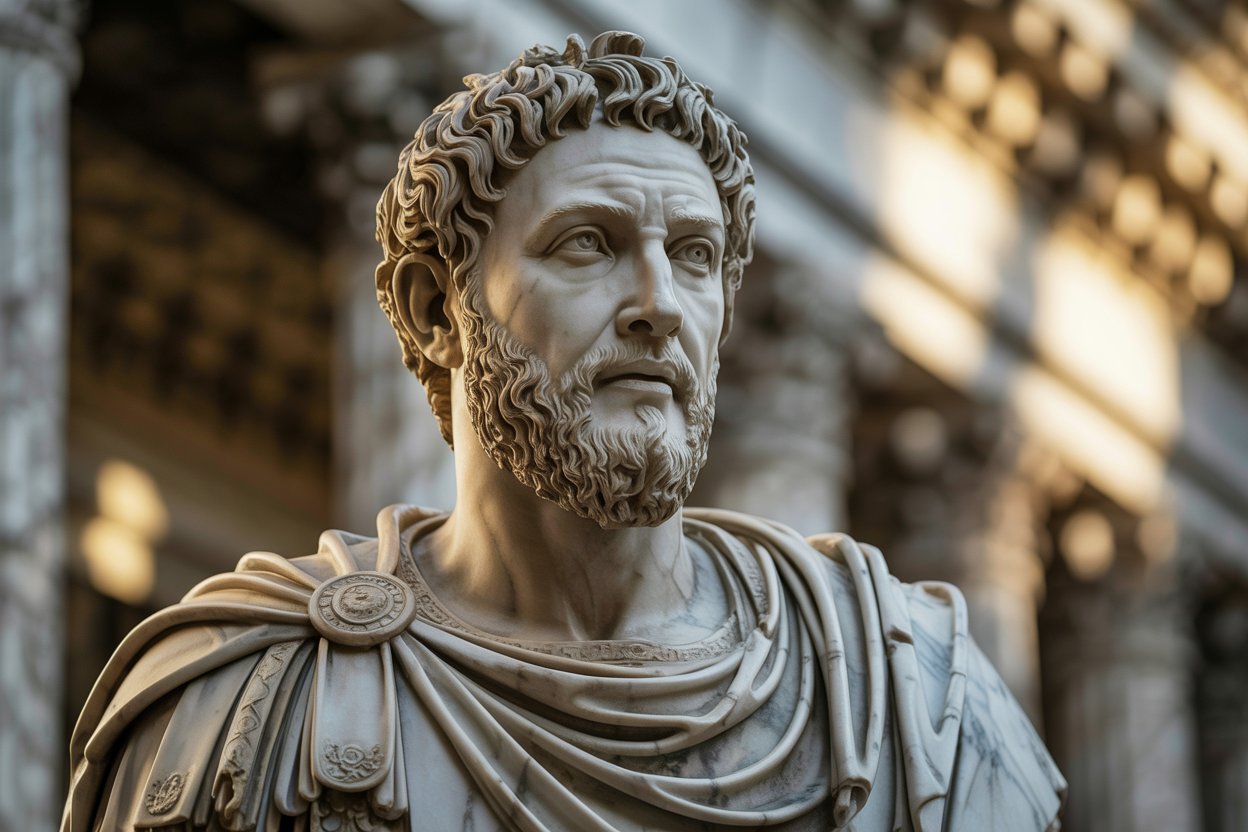
Marcus Aurelius spent nearly two decades as Emperor of Rome while quietly writing one of history’s most powerful guides to mental strength. His private journal, known today as Meditations, was never intended for an audience. It was a man coaching himself through war, betrayal, plague, and loss.
The psychology embedded in those writings has outlasted every empire that followed. Here are the ten Stoic psychology rules that strong men still live by today, drawn directly from his words.
1. Control Your Perceptions, Not Your Circumstances
Strong men understand that events are neutral. The story you tell yourself about what happened determines whether you suffer or grow strong. Marcus Aurelius taught that mental framing is the ultimate advantage.
When you master your perception, no external situation can destabilize you, as he wrote: “You have power over your mind, not outside events. Realize this, and you will find strength.” The man who controls his interpretation of events controls his entire experience of life.
2. Eliminate the Need for External Validation
The psychologically strong man stops performing for the crowd. He builds his self-worth from an internal scorecard, not from applause, titles, or the approval of strangers. Marcus understood that chasing validation is a form of voluntary servitude to others.
When you stop needing others to confirm your value, you become psychologically free. He observed: “It never ceases to amaze me: we all love ourselves more than other people, but care more about their opinion than our own.” That single insight can change a man’s entire relationship with himself.
3. Use Obstacles as Fuel for Growth
Weak psychology avoids difficulty. Strong psychology seeks the lesson in every setback. Marcus Aurelius faced plagues, betrayals, endless military campaigns, and devastating personal loss. Yet he reframed every hardship as training material for the mind.
The obstacle doesn’t block the path. For the disciplined mind, the obstacle becomes the path. He wrote: “The impediment to action advances action. What stands in the way becomes the way.” This principle alone separates men who grow through adversity from those who are destroyed by it.
4. Practice Emotional Non-Reactivity
Reacting emotionally to every provocation is a sign of an undisciplined mind. Marcus Aurelius believed that the pause between stimulus and response is where actual power lives. Strong men don’t suppress their emotions. They refuse to be enslaved by them.
They observe anger, frustration, and fear without immediately acting on impulse. As he cautioned: “How much more grievous are the consequences of anger than the causes of it.” The cost of losing control almost always exceeds the cost of whatever triggered it.
5. Accept Mortality as a Daily Motivator
Most people avoid thinking about death. The Stoic uses it as fuel. Marcus Aurelius meditated on his own mortality not to become dark or morbid, but to become urgent. When you internalize that your time is finite, trivial distractions lose their grip on you.
Petty conflicts dissolve. What remains is clarity about what actually matters. He wrote: “Think of yourself as dead. You have lived your life. Now, take what’s left and live it properly.” That urgency is what separates a man who merely exists from one who truly lives.
6. Refuse to Waste Energy on Things You Can’t Change
Mentally strong men operate within a strict energy budget. They invest their focus and effort only in what falls within their control. Their own actions, decisions, and character receive full attention. Everything else gets released.
Other people’s behavior, past mistakes, economic conditions, and outcomes beyond your influence are not worth your energy. Marcus advised: “The first rule is to keep an untroubled spirit. The second is to look things in the face and know them for what they are.” This is not passivity. It is a strategic focus at the highest level.
7. Judge Yourself by Your Actions, Not Your Intentions
The world is full of people who intend to start a business, get in shape, and repair a relationship. Marcus Aurelius had no patience for good intentions without execution. Stoic psychology demands that you close the gap between who you claim to be and what you actually do.
Your character is built by your actions, not your plans. He wrote bluntly: “Waste no more time arguing about what a good man should be. Be one.” Strong men treat that line as a daily command, not a suggestion.
8. Guard Your Mental Environment Ruthlessly
What you allow into your mind determines the quality of your life. Marcus Aurelius understood that your inner world shapes your outer results. Strong men curate their mental inputs the way a general guards a fortress.
They limit exposure to toxic people, pointless arguments, and information that serves no purpose. He warned: “The soul becomes dyed with the color of its thoughts.” If you flood your mind with negativity and distraction, that is precisely the life you will build.
9. Serve Something Greater Than Yourself
Stoicism is not a philosophy of isolation or cold detachment. Marcus Aurelius deeply believed in his duty to the community and to the people around him. Psychologically strong men find purpose by contributing to something larger than their own comfort or personal ambition.
Self-absorption leads to anxiety and emptiness. Purpose-driven action creates meaning and resilience. He wrote: “What injures the hive injures the bee.” A man disconnected from a larger purpose eventually loses connection with himself.
10. Start Every Morning with Discipline and Intention
The way you begin your day programs your psychology for everything that follows. Marcus Aurelius wrote honestly about the battle against the warm bed and the temptation to stay comfortable. He forced himself to rise with purpose every morning.
He knew that discipline in the small moments builds the mental architecture for discipline when it truly counts. As he told himself: “At dawn, when you have trouble getting out of bed, tell yourself: I have to go to work as a human being. What do I have to complain of, if I’m going to do what I was born for?” Strong men don’t wait to feel motivated. They act first and let motivation follow.
Conclusion
These ten rules are not motivational slogans. They are operating principles for building unshakeable psychology. Marcus Aurelius didn’t write them from an ivory tower. He wrote them while leading armies, losing many of his children at a young age, and managing an empire under constant threat.
His words endure because they were tested under extreme pressure. The men who internalize these Stoic psychology rules don’t just survive difficulty. They become the kind of person that difficulty can’t break.