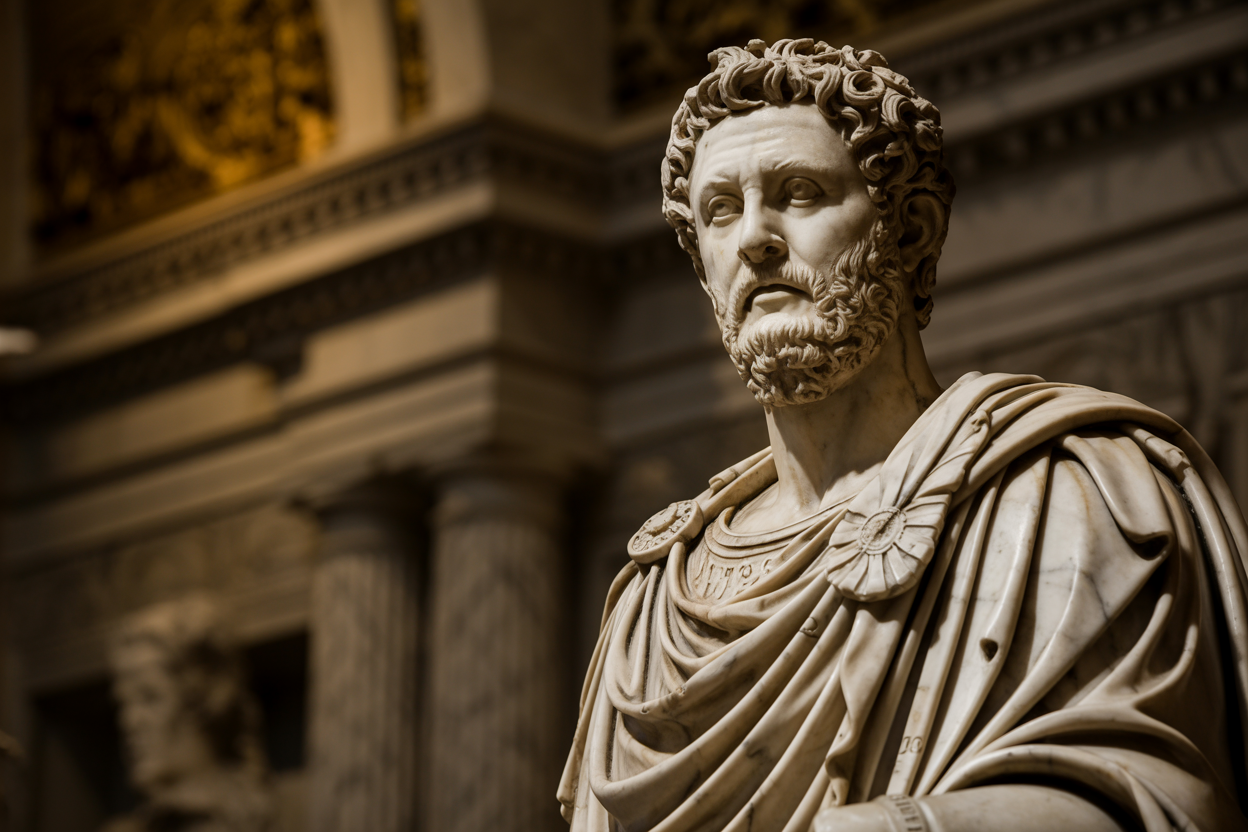
Marcus Aurelius ruled the Roman Empire during one of its most turbulent periods, yet he spent his nights writing private journal entries about self-mastery and emotional control. Those writings, known today as Meditations, contain lessons in discipline that modern psychology is only now beginning to validate. Each lesson below pairs timeless Stoic wisdom with the psychological science that explains why it works.
1. Control Your Reactions, Not Your Circumstances
“You have power over your mind — not outside events. Realize this, and you will find strength.” – Marcus Aurelius.
Stoic psychology centers on the dichotomy of control—the distinction between what depends on us and what does not. Cognitive behavioral therapy (CBT) mirrors this principle, teaching that emotional distress comes not from events themselves but from our interpretations of them.
When a man stops wasting energy on things beyond his influence and redirects that energy toward his own thoughts and actions, he builds resilience that compounds over time. Discipline begins the moment you accept that your response is the only variable you truly own.
2. Start Each Day with Intentional Preparation
“When you arise in the morning, think of what a precious privilege it is to be alive — to breathe, to think, to enjoy, to love.” – Marcus Aurelius.
Marcus Aurelius practiced a morning premeditatio — mentally rehearsing the challenges ahead so nothing could catch him off guard. Research in implementation psychology shows that people who visualize obstacles and plan responses are significantly more likely to follow through on goals.
This is not optimism; it is strategic pessimism. A disciplined man does not hope the day will go well. He prepares his mind to handle it regardless of what unfolds.
3. Eliminate the Need for External Approval
“It never ceases to amaze me: we all love ourselves more than other people, but care more about their opinion than our own.” – Marcus Aurelius.
The Stoics called this self-referral — grounding your identity in internal standards rather than the shifting opinions of others. Psychological research on locus of control confirms that individuals with an internal locus experience lower anxiety and higher motivation.
When you constantly seek validation from bosses, partners, or social media, you hand the steering wheel to people who have no stake in your destination. Proper discipline means holding yourself to your own standard, especially when nobody is watching.
4. Use Obstacles as Training Ground
“The impediment to action advances action. What stands in the way becomes the way.” – Marcus Aurelius.
This is the Stoic concept of amor fati — loving your fate, including its hardships. Post-traumatic growth research shows that individuals who reframe adversity as a catalyst often emerge with greater psychological strength, deeper relationships, and a clearer sense of purpose.
A disciplined man does not avoid difficulty. He walks toward it, knowing that the resistance is the very thing building his capacity to handle what comes next.
5. Guard Your Attention Like a Fortress
“The things you think about determine the quality of your mind. Your soul takes on the color of your thoughts.” – Marcus Aurelius.
Neuroscience has confirmed what Marcus intuited: habitual thought patterns physically reshape the brain through neuroplasticity. What you repeatedly focus on strengthens neural pathways that make those patterns automatic.
A man who fills his attention with gossip, outrage, and distraction is literally wiring his brain for reactivity. Discipline of thought is the highest form of self-discipline because it determines every action that follows.
6. Practice Voluntary Discomfort
“You could leave life right now. Let that determine what you do and say and think.” – Marcus Aurelius.
The Stoics deliberately practiced hardship — cold exposure, fasting, and sleeping on hard surfaces — to reduce their dependence on comfort. Psychological research on stress inoculation shows that controlled exposure to discomfort builds tolerance and reduces anxiety responses.
When a man voluntarily chooses the more challenging path in small daily decisions, he trains his nervous system to stay calm under pressure. Comfort is the enemy of discipline because it teaches you to avoid precisely what would make you stronger.
7. Stop Complaining and Take Ownership
“Accept the things to which fate binds you, and love the people with whom fate brings you together, and do so with all your heart.” – Marcus Aurelius.
Complaining activates the brain’s negativity bias and reinforces learned helplessness — the psychological state where a person believes their actions have no effect on outcomes. Studies on self-efficacy show that people who take ownership of their situations, even unfair ones, maintain higher motivation and better mental health.
A disciplined man does not waste words describing problems. He channels that energy into executing solutions. Ownership is not about fault. It is about refusing to be passive in your own life.
8. Master the Art of Delayed Gratification
“Think of yourself as dead. You have lived your life. Now, take what’s left and live it properly.” – Marcus Aurelius.
Marcus Aurelius urged urgency paired with patience — act decisively but invest in long-term outcomes. The famous Stanford marshmallow experiment demonstrated that children who delayed gratification achieved higher SAT scores, better health, and greater financial stability decades later.
Discipline is fundamentally the ability to choose long-term results over short-term impulses. Every time a man says no to an easy pleasure in favor of a meaningful goal, he strengthens the prefrontal cortex circuits that govern self-control.
9. Conduct a Nightly Self-Audit
“Waste no more time arguing about what a good man should be. Be one.” – Marcus Aurelius.
The Stoics ended each day with an evening review — examining what went well, what went poorly, and what could be improved. This practice aligns with modern reflective journaling research, which shows that structured self-reflection improves self-awareness, emotional regulation, and goal attainment.
A disciplined man does not let days blur together without accountability. He treats each evening as a performance review for his own character, making adjustments before the next day begins.
10. Keep Death Close to Stay Fully Alive
“It is not death that a man should fear, but he should fear never beginning to live.” – Marcus Aurelius.
Memento mori — the meditation on mortality — was central to Stoic practice. Terror management theory in psychology confirms that awareness of death, when processed constructively, increases motivation and clarifies priorities.
Men who avoid thinking about death tend to drift through years on autopilot. Men who confront it use the awareness as fuel. Discipline rooted in mortality is not morbid. It is the most honest form of self-motivation because it strips away every excuse and forces you to act on what truly matters while you still can.
Conclusion
Marcus Aurelius had access to unlimited wealth, power, and comfort, yet he chose discipline over indulgence every single day. His private writings prove that self-mastery is not about willpower alone — it is about training your psychology to work for you rather than against you.
These ten lessons are not philosophical abstractions. They are practical tools that rewire how a man thinks, responds, and builds his life.