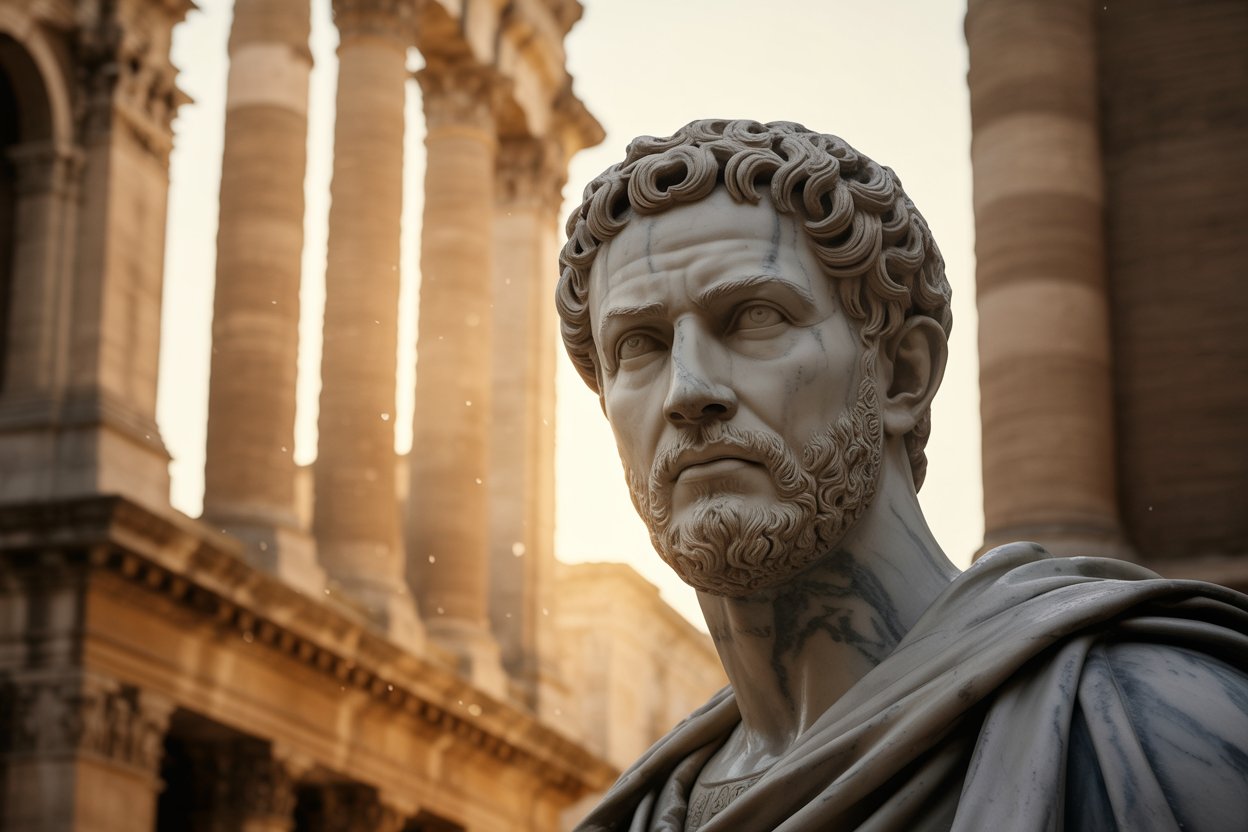
The ancient world produced countless philosophical texts, but few have maintained their relevance across centuries quite like Marcus Aurelius’ Meditations. Written nearly two thousand years ago by a Roman emperor facing plague, war, and political turmoil, this collection of personal reflections offers timeless wisdom on how to live a meaningful life.
The text wasn’t intended for publication—these were private notes, a philosophical journal where Marcus wrestled with the challenges of leadership and mortality. Yet this intimate quality makes Meditations particularly powerful for modern readers seeking practical philosophy rather than abstract theory.
1. The Philosopher Emperor
Marcus Aurelius ruled the Roman Empire from 161 to 180 CE during one of its most challenging periods. He inherited an empire facing constant military threats along its borders, economic strain, and a devastating plague that killed millions.
Unlike many rulers who might have turned to despotism or escapism under such pressure, Marcus maintained his commitment to Stoic philosophy throughout his reign. His position creates a fascinating paradox—here was the most powerful man in the known world, someone who controlled vast armies and wealth, dedicating himself to a philosophy that emphasized the insignificance of external circumstances and the primacy of inner virtue.
Marcus didn’t write Meditations from the comfort of a philosophical academy but from military camps along the frontier, often while dealing with the immediate realities of war and governance. This context is significant because it demonstrates that Stoic principles weren’t merely theoretical exercises for the emperor, but practical tools for navigating extreme stress and responsibility.
2. Understanding Stoic Philosophy
To appreciate Meditations, you need to grasp the fundamentals of Stoic philosophy. The Stoics believed that the path to happiness and tranquility lies in accepting what you can’t control while focusing entirely on what you can—primarily your own thoughts, judgments, and actions.
This isn’t passive resignation but an active choice to direct your energy toward meaningful areas where you actually have agency. The Stoics made a crucial distinction between external events and our interpretations of those events.
They argued that suffering comes not from the events themselves but from our judgments about them. A business failure isn’t inherently bad—it becomes bad only when we judge it as such and attach feelings of shame or despair to the outcome. This perspective doesn’t deny the reality of difficult circumstances, but instead reframes how we mentally and emotionally relate to them.
Stoicism also emphasized living in accordance with nature and reason. For the Stoics, humans are rational and social creatures, so our highest good involves using reason to guide our actions and contributing positively to our communities.
Virtue—defined as wisdom, courage, justice, and self-control—was considered the only true good, while things like wealth, fame, and pleasure were classified as “preferred indifferents.” They might be nice to have, but they can’t make you a better person or guarantee fulfillment.
3. The Core Teachings of Meditation
Meditations returns repeatedly to several key themes that form the heart of the Stoic ideal. One central teaching is the brevity of life and the importance of living each day as if it might be your last.
Marcus frequently reminds himself that life is short and death is inevitable, not to create morbid anxiety but to inspire urgency and intentionality. When you truly internalize your mortality, trivial concerns fall away, and you focus on what genuinely matters.
Another prominent theme is the interdependence of all people. Marcus emphasizes that humans are social beings designed to work together and help one another. He instructs himself to be patient with others’ faults and mistakes, recognizing that we all share common human weaknesses.
This perspective creates a foundation for compassion without naivety—you can acknowledge that people will sometimes disappoint you while maintaining goodwill toward them. The text also stresses the power of perception and the mind’s ability to shape experience.
Marcus returns again and again to the idea that external events are neutral until we assign them meaning through our judgments. If you view an obstacle as a disaster, it becomes one. If you view it as a challenge or an opportunity for growth, it can transform into something potentially valuable. This isn’t positive thinking in the superficial sense but rather a sophisticated understanding of how cognition shapes emotional experience.
Perhaps most importantly, Meditations emphasizes the practice of self-examination and constant renewal. Marcus treats each day as an opportunity to align his actions with his principles. He doesn’t expect perfection but maintains a commitment to continuous improvement. When he falls short, he notes it, learns from it, and begins again the next day.
4. Practical Application Today
The remarkable staying power of Meditations stems from its practical applicability to modern challenges. The specific circumstances of Roman imperial politics might be distant, but the underlying human struggles—stress, loss, complex relationships, mortality, and the search for meaning—remain constant.
Consider workplace stress and professional setbacks. Marcus’s emphasis on controlling only what you can control offers a powerful antidote to anxiety about outcomes beyond your influence. You can’t control whether you get the promotion, but you can control the quality of your work and how you respond to decisions. This distinction doesn’t eliminate disappointment, but it channels your energy productively rather than wasting it on resentment or rumination.
The Stoic approach to difficult people proves equally relevant. Marcus’s practice of starting each day by reminding himself that he’ll encounter challenging individuals—and that getting angry serves no purpose—provides a framework for maintaining equanimity in contentious interactions. When you expect difficulties and see them as opportunities to practice patience and understanding, you’re less likely to be derailed by conflict.
The emphasis on mortality also has immediate applications. Modern life often encourages distraction and deferral—we’ll pursue meaningful goals later, once circumstances are perfect. Marcus’s reminder that life is brief and uncertain fosters a healthy sense of urgency. It prompts you to ask whether your current activities align with your values and whether you’re postponing what truly matters.
Conclusion
Marcus Aurelius’ Meditations endures because it addresses the fundamental human challenge of living well in a world you can’t fully control. The Stoic ideal it presents isn’t about suppressing emotions or becoming indifferent to outcomes.
It’s about developing mental resilience, maintaining ethical principles regardless of circumstances, and finding peace through accepting what you can’t change while fully engaging with what you can.
The text’s private nature makes it particularly instructive. This wasn’t philosophy performed for an audience but honest self-reflection by someone bearing enormous responsibility. Marcus struggled with the same difficulties we face—frustration, temptation, mortality, and the challenge of maintaining integrity in the face of pressure.
His solutions, grounded in Stoic principles, offer a practical philosophy for building inner stability in an unstable world. The wisdom isn’t that external circumstances don’t matter, but that your response to them matters more.