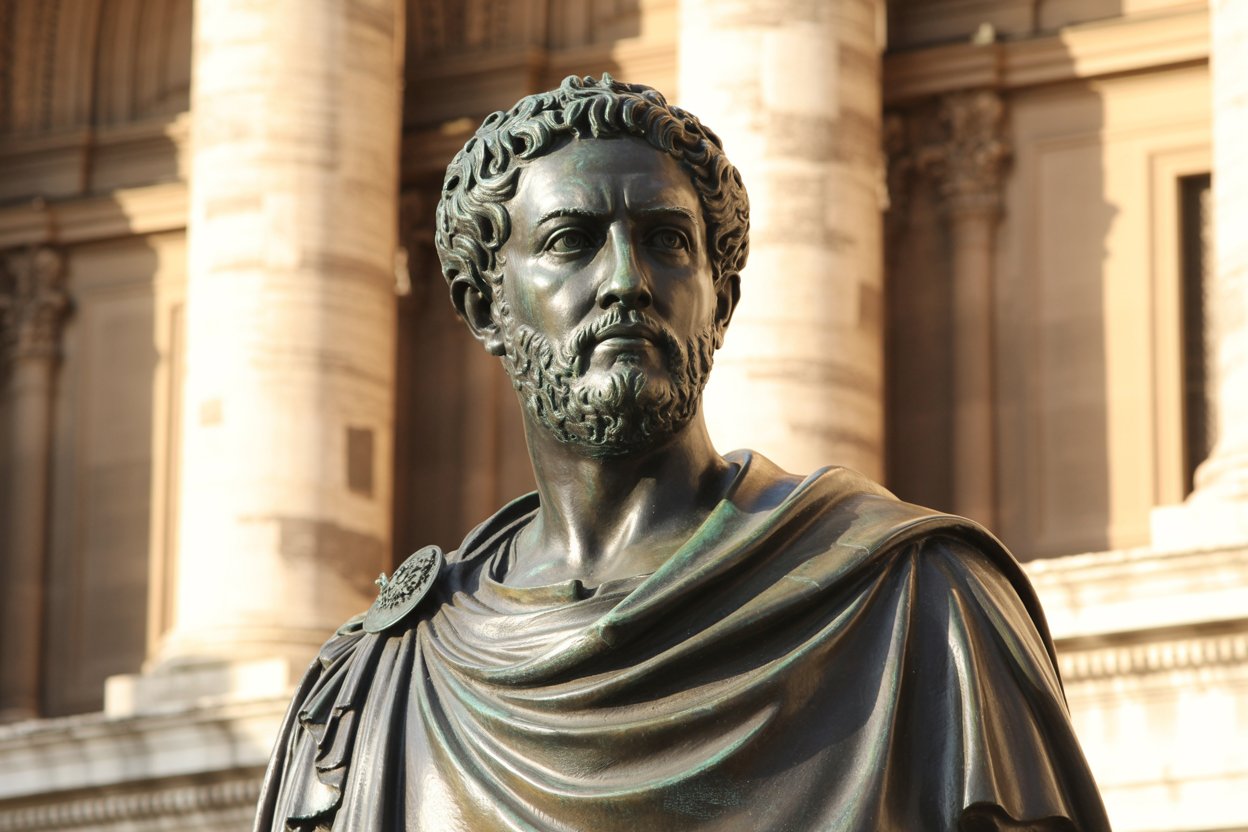
“Do not disturb yourself by imagining your whole life at once” — Marcus Aurelius
Marcus Aurelius, the Roman Emperor and Stoic philosopher, understood the overwhelming anxiety that comes from trying to process your entire life’s trajectory all at once. His meditation on focusing on the present moment rather than becoming paralyzed by imagining every future scenario remains remarkably relevant for anyone building wealth, making career decisions, or navigating life’s complexities.
This principle, drawn from his personal journal, Meditations, provides a practical framework for managing the psychological burden associated with long-term planning and ambitious goals. Let’s explore this quote in detail.
1. What Marcus Aurelius Really Meant
Marcus Aurelius wrote Meditations as private notes to himself while serving as emperor of Rome from 161 to 180 AD. Facing extraordinary pressures—managing an empire, military threats, political intrigue, and personal tragedies, including the loss of several children—he needed practical tools to maintain psychological equilibrium.
The quote reflects a fundamental Stoic principle: we can’t control the future, but we can control how we respond to the present moment. Emperor Aurelius recognized that when we mentally project ourselves into an imagined future containing every possible challenge, setback, and obstacle we might face, we create unnecessary suffering.
This anxiety doesn’t help us prepare better; it simply drains mental and emotional resources that could be applied to what’s actually in front of us right now.
2. Why Imagining Your Whole Life Creates Paralysis
When you attempt to visualize your entire life trajectory simultaneously, several psychological problems emerge. The sheer volume of potential variables becomes overwhelming. You start calculating every possible outcome: market crashes, job losses, health problems, failed relationships, business failures. Each hypothetical branches into more hypotheticals, creating an exponentially complex web of anxiety.
This mental exercise mistakes imagination for preparation. You might think you’re being prudent by anticipating every scenario, but you’re actually engaging in unproductive worry. Real preparation involves taking concrete action on what you can control today, not mentally rehearsing catastrophes you can’t prevent or predict.
Most importantly, imagining your whole life at once robs you of agency in the present moment. When you’re mentally scattered across decades of imagined scenarios, you can’t fully engage with actual decisions and opportunities right in front of you.
The person trying to plan their entire financial future down to retirement might miss the skill-building opportunity available this week that could fundamentally change their trajectory.
3. The Stoic Alternative: Present-Moment Focus
Instead of imagining your whole life, Stoicism offers a different approach: intense focus on what’s immediately within your control. Marcus Aurelius would ask himself what specific challenge he faced in this moment and what action he could take right now.
This doesn’t mean ignoring the future or abandoning long-term planning. It means breaking down overwhelming future projections into actionable steps in the present moment. For someone building wealth, rather than becoming paralyzed by trying to calculate exactly how you’ll retire comfortably in forty years while accounting for every variable, focus on the financial decision at hand today.
Can you increase your savings rate this month? Can you improve your skills this quarter? Can you make one wise investment decision this week?
The Stoics understood that life unfolds sequentially, not all at once. You can’t live all your years simultaneously, so why torture yourself trying to experience them all mentally right now? Each moment arrives in its turn, bringing specific circumstances you can’t fully predict. Your job is to meet each moment with clarity and purpose, not to fast-forward through decades of imagined scenarios mentally.
4. How to Apply This Principle to Wealth Building
This Stoic wisdom directly challenges the modern financial planning tendency to encourage excessive focus on detailed forty-year projections. While having general direction is valuable, the person spending hours agonizing over whether they’ll have exactly $2.3 million or $2.5 million at retirement is wasting mental energy that could be better spent on present-moment wealth-building actions.
Consider two approaches. The first person creates elaborate spreadsheets that project their net worth for thirty years, accounting for numerous variables and running multiple scenarios. They spend their weekends worrying about market crashes that haven’t happened, inflation rates they can’t control, and job losses that might never materialize. They’re paralyzed by complexity.
The second person sets a general direction, then focuses intensely on what they can control today. They develop valuable skills this month. They maintain savings discipline this week. They make thoughtful investment decisions as opportunities arise. They adapt to actual circumstances as they unfold rather than trying to solve imaginary future problems preemptively.
The second approach aligns with Marcus Aurelius’ wisdom. It acknowledges that life rarely follows neat projections. Markets behave unpredictably. Career paths take unexpected turns. Opportunities arise that you couldn’t have anticipated. By staying present and focused on what’s actually in front of you, you maintain the flexibility and mental clarity needed to capitalize on opportunities and navigate challenges as they actually appear.
5. Breaking Down Goals into Present Actions
The practical application involves a simple shift: whenever you feel overwhelmed by imagining your whole life or entire journey toward a goal, ask yourself what specific action you can take today. Not tomorrow, not next year, but right now. What’s the immediate next step?
If you’re building a business, you don’t need to solve every challenge you’ll face over the next decade simultaneously. You need to handle the specific task at hand today—making one sales call, improving one product feature, or solving one operational problem. Each present-moment action compounds over time, but only if you’re actually present for it.
This approach also applies to skill development. The person wanting to become financially literate doesn’t need to feel overwhelmed by everything they don’t know. They need to learn one concept today. Read one chapter. Practice one skill. The person who consistently shows up for small, present-moment actions will outpace the person paralyzed by imagining the enormity of the entire journey.
Conclusion
Marcus Aurelius’ counsel to avoid disturbing yourself by imagining your whole life at once offers more than stress relief—it provides a practical framework for effective action.
By focusing on what’s immediately within your control rather than becoming overwhelmed by imagining every possible future scenario, you free up mental and emotional resources for the decisions and actions that actually matter.
This doesn’t mean living recklessly without any thought for the future. It means trusting that by handling each present moment with wisdom and purpose, you’re building the best possible future without the psychological burden of trying to live it all in advance.
The Stoics understood that life unfolds one moment at a time, and the person who can fully engage with each moment as it arrives will navigate their journey more effectively than the person who is paralyzed by trying to experience it all mentally at once.