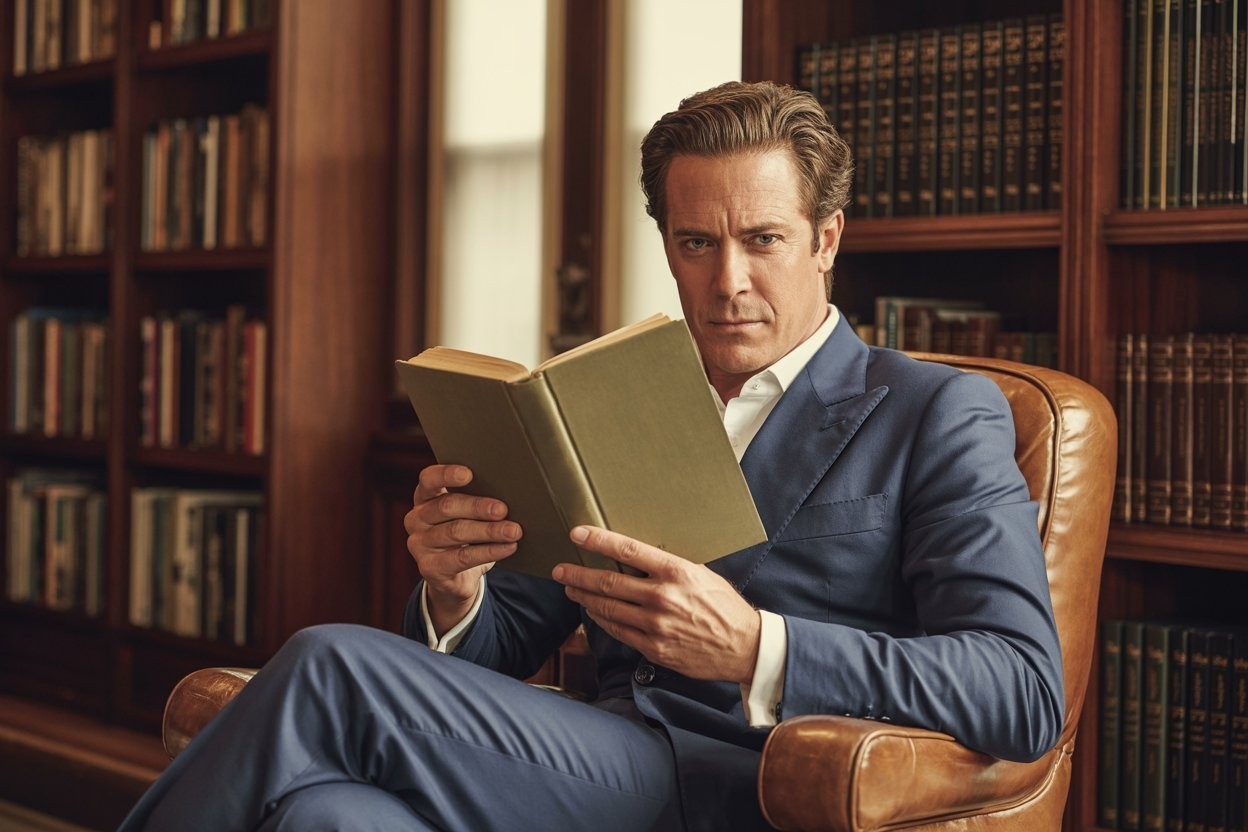
The wealthiest individuals don’t just read different books than the middle class. They read books that fundamentally challenge how most people think about money, success, and personal growth. These aren’t quick-read self-help guides promising overnight transformation.
They’re dense, uncomfortable, and often contradict the traditional societal teachings about building wealth. The middle class typically avoids these books because they demand genuine intellectual effort and challenge deeply held beliefs about how the world works. Here are ten books that separate wealthy thinkers from everyone else.
1. “Poor Charlie’s Almanack” by Charlie Munger
This collection of wisdom from Warren Buffett’s business partner sits unread on countless shelves because it requires serious mental work. Munger doesn’t offer simple wealth-building tips or motivational platitudes. Instead, he presents a framework for multidisciplinary thinking that pulls from psychology, mathematics, biology, and physics.
The middle class wants actionable steps they can implement by Friday. Munger demands you rewire entirely how you process information and make decisions. His mental models approach requires studying multiple fields and understanding how they interconnect, which feels overwhelming to those seeking quick answers to complex financial questions.
2. “Influence: The Psychology of Persuasion” by Robert Cialdini
Wealthy individuals study Cialdini’s work to understand the psychological triggers that drive human behavior and decision-making. The book dissects six principles of persuasion that govern how people think and act. The wealthy utilize this knowledge to establish businesses, negotiate favorable deals, and safeguard themselves against manipulation.
The middle class often avoids this book because understanding persuasion tactics feels morally uncomfortable. The idea that human behavior follows predictable patterns threatens the belief in free will and rational decision-making. However, wealthy readers recognize that understanding these principles is essential for both ethical business practices and personal protection from exploitation.
3. “Thinking, Fast and Slow” by Daniel Kahneman
This Nobel Prize winner’s exploration of cognitive biases represents decades of groundbreaking research into how humans actually think versus how they perceive themselves thinking. The book is dense, challenging, and forces readers to confront their own irrational thought patterns. Wealthy individuals embrace this discomfort because they understand that acknowledging their biases is the first step toward making better decisions.
The middle class skips this book because admitting that your brain systematically deceives you is painful work. It doesn’t promise immediate financial returns or simple strategies you can implement tomorrow. Instead, it offers the long-term benefit of improved thinking, which requires patience and humility that many people can’t muster.
4. “Unscripted” by MJ DeMarco
DeMarco challenges the default life script that society hands everyone: get good grades, attend college, secure a stable job, save for retirement. This script feels safe and socially acceptable. Wealthy thinkers reject this predetermined path because they recognize it leads to mediocrity, not financial freedom.
The middle class tends to avoid this book because questioning the traditional script feels risky and even irresponsible. Parents, teachers, and society have reinforced this path for generations. DeMarco argues that real wealth comes from designing your own systems rather than following someone else’s blueprint, which requires the courage that most people lack.
5. “Secrets of the Millionaire Mind” by T. Harv Eker
Eker focuses on your financial blueprint, the subconscious programming that determines your relationship with money. The middle class often dismisses this as pseudoscience or motivational nonsense. They prefer concrete strategies over the idea that invisible thought patterns control their financial outcomes.
Wealthy individuals understand that if your internal thermostat is set to “comfortable,” you’ll subconsciously sabotage any attempt to become truly rich. You’ll find ways to spend windfalls, avoid opportunities, or create problems that keep you at your comfort level. Addressing these deeply rooted beliefs requires an uncomfortable self-examination that feels too abstract for people seeking practical advice.
6. “The Millionaire Fastlane” by MJ DeMarco
The title sounds like a get-rich-quick scheme, which causes many middle-class readers to dismiss it immediately. However, DeMarco actually delivers a brutal critique of the traditional “Slowlane” approach to wealth building. He argues that saving 10% of a modest salary for 40 years is a fundamentally flawed strategy.
The book teaches that true wealth comes from creating controllable systems that generate value and impact, rather than relying on compounding investment returns on employee income. This message threatens everything the middle class has been taught about financial security. It suggests that the safe path they’ve chosen leads to mediocrity, which is too painful for most people to accept.
7. “How Rich People Think” by Steve Siebold
Siebold interviewed over 1,200 of the world’s wealthiest individuals and documented the thought patterns that distinguish them from others. His central conclusion is that becoming rich is fundamentally a way of thinking, not a matter of education or circumstances. The middle class believes money is the root of all evil, while the wealthy believe poverty is the root of all evil.
This moral flip is too radical for most people raised with traditional values about money. Wealthy individuals view money as a tool that amplifies their positive impact, while the middle class tends to view it with suspicion and guilt. Changing this fundamental belief system requires questioning values instilled since childhood.
8. “Think and Grow Rich” by Napoleon Hill
Hill’s classic draws from interviews with successful figures, such as Andrew Carnegie, and outlines principles of desire, persistence, and mindset reprogramming. Wealthy readers apply the systematic goal-setting framework and understand that Hill documented actual patterns among successful people. They recognize the book as a blueprint for focused achievement.
The middle class dismisses it as outdated motivation or wishful thinking. The language feels obsolete, and the concepts seem too simplistic to be effective. However, wealthy individuals understand that simple doesn’t mean easy, and the book’s enduring relevance proves its principles transcend time periods.
9. “The Psychology of Money” by Morgan Housel
Despite being highly accessible and well-written, the middle class often avoids Housel’s work because it argues that behavior matters more than intelligence or knowledge when it comes to financial success.
This message threatens people who’ve invested heavily in credentials, degrees, and expertise. Housel shows that smart people make terrible financial decisions while others with less education build substantial wealth through consistent behavior.
The book demonstrates that financial success depends more on controlling your emotions, delaying gratification, and maintaining a long-term perspective than on sophisticated investment knowledge. For those who’ve based their identity on being intelligent or educated, this message feels insulting rather than liberating.
10. “Zero to One” by Peter Thiel
Thiel argues for creating monopolies and avoiding competition entirely. He suggests that the best businesses don’t compete in existing markets but create entirely new categories. This philosophy contradicts everything the middle class has been taught about hard work, fairness, and playing by established rules.
The middle class believes success comes from working harder than competitors within existing systems. Thiel argues this approach leads to mediocrity because you’re fighting over scraps in crowded markets. Wealthy thinkers embrace his message because they recognize that real fortunes come from innovation and market creation, not from incremental improvement in competitive fields.
Conclusion
The pattern across these ten books is unmistakable. Wealthy individuals gravitate toward books that demand uncomfortable self-examination, challenge conventional wisdom, and require long-term thinking without promising quick results. These books don’t offer simple tips you can implement over a weekend.
They ask you to fundamentally change how you think about money, success, and human behavior. The middle class tends to avoid them because this work is often painful, threatening, and offers no guarantee of immediate results. However, wealthy readers understand that changing your thinking is the only path to changing your financial reality.