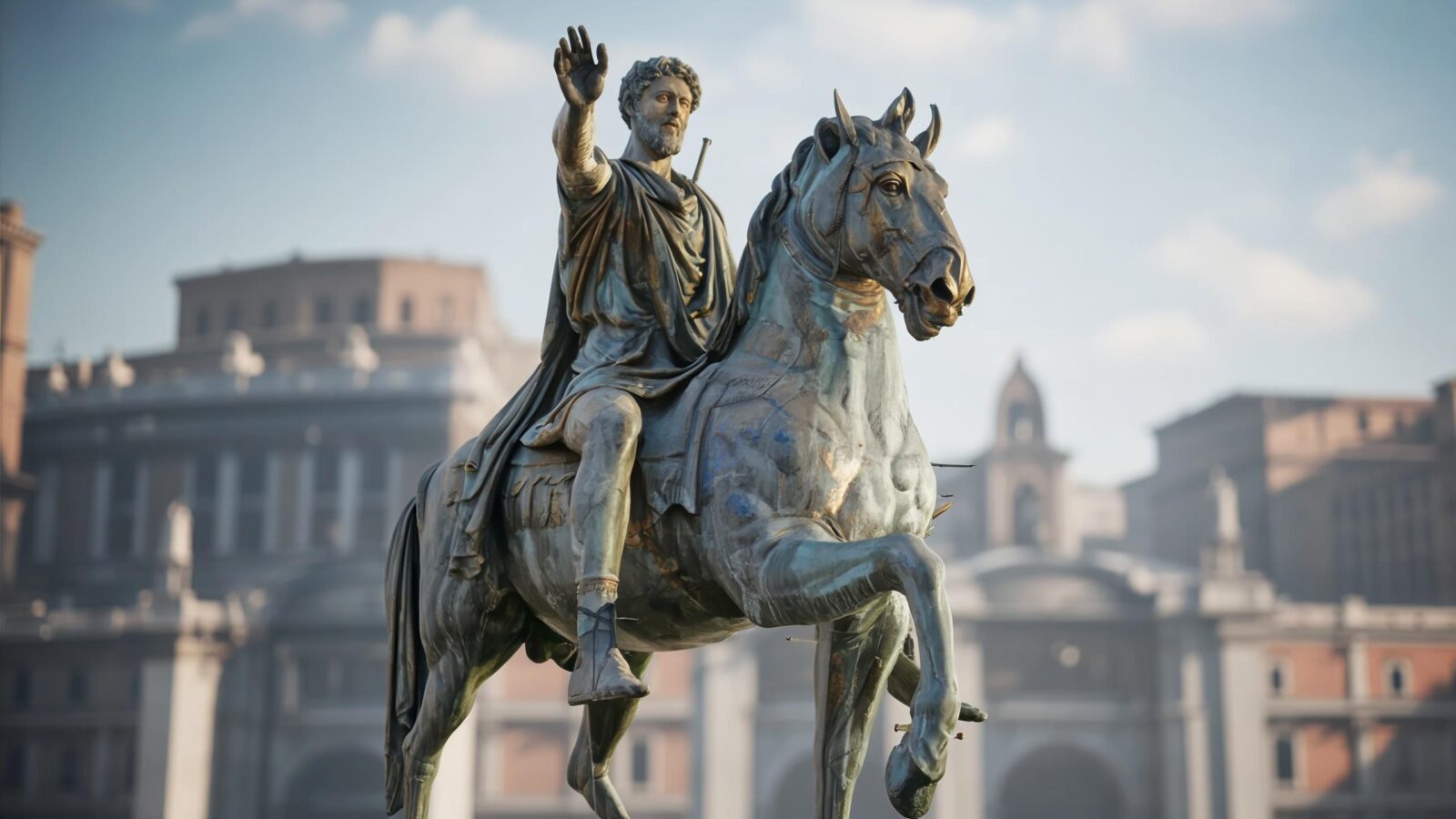
Marcus Aurelius never set out to write a self-help book. He wrote Meditations as a private journal, working through his own anxiety, anger, and doubt one entry at a time while running an empire under constant pressure.
What’s striking, almost two thousand years later, is how closely his personal notes align with modern psychology. Cognitive Behavioral Therapy, stress inoculation training, exposure therapy, and post-traumatic growth all show up in his pages in some form, long before any of those terms existed. Here are five of his habits and the research that backs each one up.
1. Reframing Thoughts (Cognitive Restructuring)
“The happiness of your life depends upon the quality of your thoughts.” Marcus Aurelius wrote that line to himself, in a tent or a palace room, long before anyone called it a technique. He was a Roman emperor scribbling notes he never expected anyone else to read.
Cognitive Behavioral Therapy rests on almost the same premise, nearly two thousand years later. An event doesn’t create the emotion. The story you tell about the event does. A canceled meeting can read as an insult or as free time, depending entirely on which sentence runs through your head first.
This is why practicing the swap matters. Catching a catastrophic thought and replacing it with a calmer, more accurate one is a skill that improves with repetition. A person who trains his mind for this daily reacts to a bad day very differently than one who never bothers.
The habit compounds. A single reframed thought changes little on its own. A thousand of them, spread across months, start to change how a person moves through ordinary friction, from a missed flight to a difficult client call.
2. Focus on What You Can Control (Locus of Control)
One of the most quoted lines from Meditations reads: “You have power over your mind, not outside events. Realize this, and you will find strength.” It’s a short sentence. It carries the weight of a whole philosophy.
Psychologists describe this as an internal locus of control. People who believe their choices shape their outcomes tend to show higher self-efficacy. They also tend to recover from setbacks faster than people who feel that everything happens to them.
Accepting what you can’t change frees up energy for what you can. A person who stops arguing with the weather, the market’s mood, or a stranger’s opinion has more attention left for the parts of the day that are actually within reach. That’s not resignation. It’s redirection.
This distinction shows up clearly in trading. A trader can’t control whether a stock gaps down overnight. A trader can control position size, stop placement, and whether the next decision is made calmly or in a panic. Marcus Aurelius drew the same line between what belongs to a person and what doesn’t, and he drew it every single day.
3. Practice Negative Visualization (Pre-Mortem Thinking)
Marcus Aurelius began some mornings with a warning to himself: “When you wake up in the morning, tell yourself: the people I deal with today will be meddling, ungrateful, arrogant, dishonest, jealous, and surly. None of them can hurt me.” He wasn’t bracing for the worst out of pessimism. He was inoculating himself against surprise.
Stoics called this premeditatio malorum, the premeditation of troubles. Modern psychology has its own version, known as stress inoculation training. Surgeons rehearse complications before they happen. Pilots run failure scenarios in a simulator long before an engine actually stalls.
The point isn’t gloom. Rehearsed difficulty lands softer than difficulty you never saw coming. A person who has already imagined a bad week handles the real one with steadier hands than someone caught flat-footed by it.
Athletes use a close cousin of this practice before a big competition. A runner who has mentally walked through cramping legs and a bad start doesn’t fall apart when either happens. The rehearsal doesn’t guarantee a good outcome. It just removes the shock that usually makes a bad outcome worse.
4. Practice Voluntary Hardship (Desensitization)
Marcus Aurelius wrote about the posture of “receiving without pride, and letting go without attachment.” Stoics of his time practiced this literally. They would sleep on the floor for a stretch, eat plain food, or wear a coarse cloak in cold weather, choosing discomfort instead of stumbling into it.
Exposure therapy operates on a similar logic today. Distress tolerance grows through controlled contact with discomfort, not through constant avoidance of it. Someone who never sits with small irritations tends to fall apart the first time a large one arrives.
There’s a second benefit tucked inside this practice. Psychologists call it hedonic adaptation, the tendency to settle back to a baseline mood no matter how good things get. Choosing occasional hardship on purpose keeps a person from becoming numb to the comforts they’d otherwise take for granted.
A simple version of this shows up in daily life without much drama. Taking a cold shower, skipping a meal, or driving the long way instead of calling a car costs almost nothing. Over time, it builds a kind of quiet confidence that comfort alone never produces.
5. Reframe Adversity as Opportunity (Post-Traumatic Growth)
Perhaps the single most repeated line from Meditations is this one: “The impediment to action advances action. What stands in the way becomes the way.” A short sentence, and it flips an entire way of facing trouble.
Researchers today study a related idea called post-traumatic growth. An obstacle ceases to be mere interference and becomes the actual material a person is working with. Cognitive reappraisal, viewing a setback as useful information rather than a verdict, sits at the center of this shift.
This reframe turns passive suffering into something closer to training. A blown trade, a rejected pitch, or a bad quarter can either end a person’s effort or sharpen it. Marcus Aurelius chose the second option daily, on purpose, for years.
History gave him plenty of practice material. Plague swept through the empire during parts of his reign. War dragged on for years along the northern frontier. He didn’t get to choose his obstacles, only how he responded to them, which was exactly the point he kept reminding himself in his private notebook.
Conclusion
Marcus Aurelius had no access to a psychology journal. He had a stylus, a set of private notebooks, and a demanding job running an empire under constant pressure. What he left behind reads less like philosophy and more like a working manual for staying steady.
The overlap with modern clinical practice isn’t a coincidence. Human minds haven’t changed much in two thousand years, even if the tools for studying them have. The five habits above are simple enough to start today, whether the pressure in your life comes from a portfolio, a business, or an ordinary hard week.
None of them requires special equipment or a spare hour. A reframed thought, a controlled focus, a rehearsed setback, a chosen discomfort, and a reframed obstacle can each start in the next five minutes. Marcus Aurelius didn’t write Meditations for readers. He wrote it for himself, one hard morning at a time, and that’s probably why it still works.