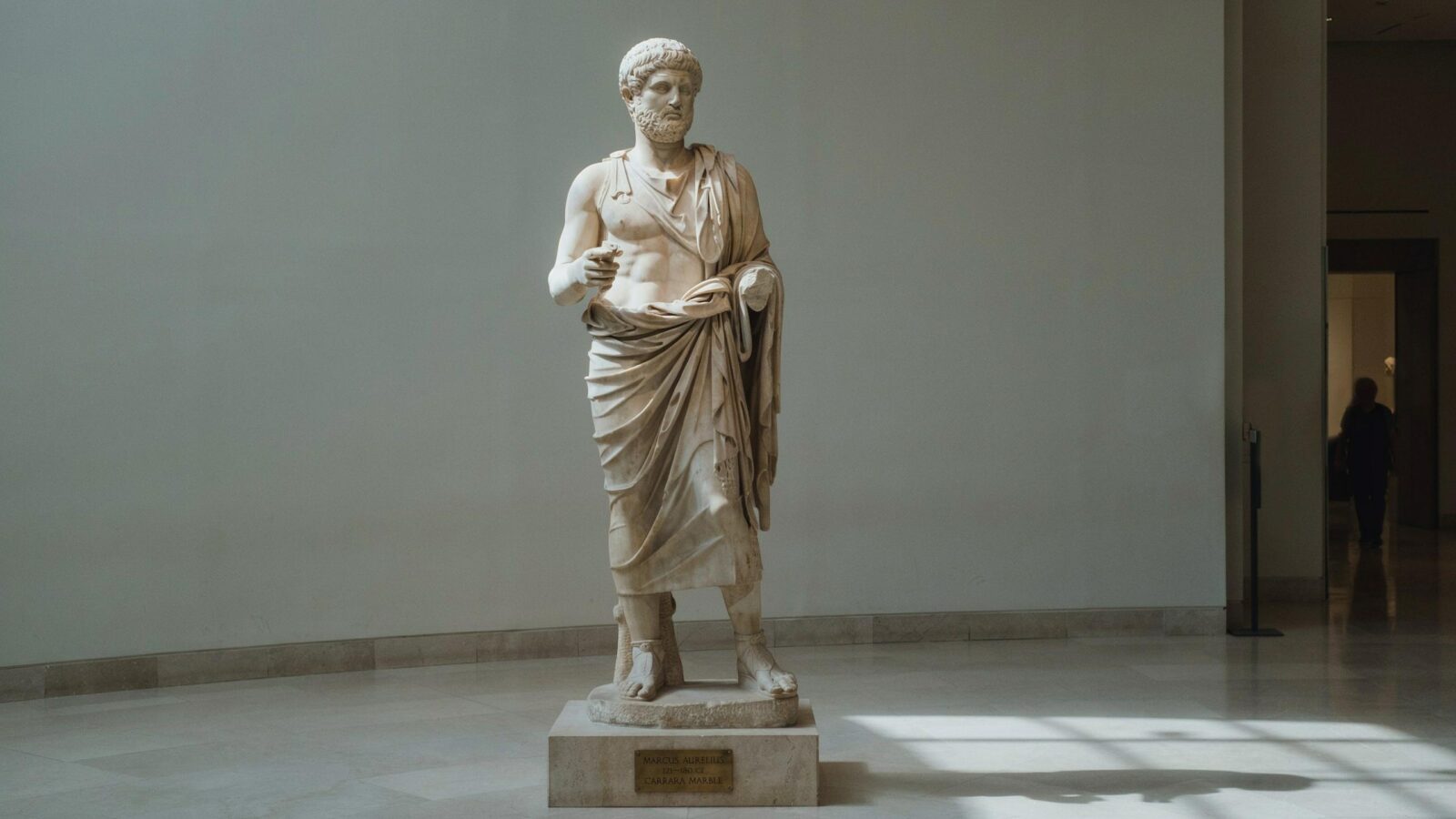
Marcus Aurelius ruled Rome from 161 to 180 AD, and his reign was rarely quiet. A plague swept through the empire, wars dragged on along the Danube frontier, one of his most trusted generals declared himself emperor, and several of his children died young.
He kept a private notebook throughout it all. We call it Meditations today, although most scholars believe he never meant it for publication. Its pages show a man working hard to keep his temper and his judgment intact, and the methods he used still hold up for anyone under pressure now.
1. The Dichotomy of Control
Stoic calm starts with a simple mental framing. Some things are yours to decide, and most of what happens around you isn’t.
Other people’s actions and the outcome of events sit outside your direct control. What you think about those events, and what you do next, belong entirely to you.
“If you are pained by any external thing, it is not this thing that disturbs you, but your own judgment about it. And it is in your power to wipe out this judgment now.” – Marcus Aurelius.
A lot of daily stress comes from pouring energy into things that won’t change no matter how hard you push. The market will open where it opens. Your coworker will be in a bad mood or he won’t.
So when something goes wrong, stop and ask whether any part of it is actually yours to control. If none of it is, accept the situation and put everything you have into your response.
Traders tend to learn this the expensive way. You can choose your entry and your stop, but you can’t make price go where you want it to.
2. Objective Perception
An event arrives without a label attached. You supply the label, and that label decides whether the moment feels like a nuisance or a catastrophe. Most emotional turbulence comes from the story told about an event. A missed deadline is a fact, while “my career is ruined” is a narrative stacked on top of that fact.
“Reject your sense of injury and the injury itself disappears.” – Marcus Aurelius.
He saw that the sting of an insult or a setback lives mostly in how we judge it. Try describing a bad moment the way a court reporter would. Drop “This is a total disaster” and say “A problem occurred, and I need to resolve it.”
A losing trade works the same way. The loss is a number on a screen, and calling it proof that you’re a bad trader is a story you added yourself. It feels awkward the first few times. After a while, the plain version starts to come first, and the urge to panic has less to grab onto.
3. Turning Obstacles into Fuel
Most people treat an obstacle as an interruption. Marcus Aurelius treated it as material to work with.
Wishing events had gone differently changes nothing. Patience and courage only grow when they’re tested, so a hard week is the best training you’ll get.
“The mind adapts and converts to its own purposes the obstacle to our acting. The impediment to action advances action. What stands in the way becomes the way.” Marcus Aurelius
Centuries later, Friedrich Nietzsche coined the phrase amor fati, meaning “love of fate,” to describe a similar attitude. He argued that a person should love what happens, including the painful parts.
In practice, treat each difficulty as training. A delayed flight is patience practice. An argument with a colleague is a chance to hold a boundary without raising your voice.
4. The Inner Citadel
Plenty of people look for calm on vacation or in a bigger bank account. Marcus Aurelius thought you could find it without going anywhere.
He described a mind free from destructive emotions as a citadel, a fortress that nothing from the outside could breach. The scholar Pierre Hadot later titled his well-known study of Meditations, The Inner Citadel, after that image.
“Nowhere can man find a quieter or more untroubled retreat than in his own soul.” – Marcus Aurelius. This came from a man with palaces at his disposal, and he still located his refuge inside his own head.
Before you react to anything, pause and step inward. Two or three slow breaths are usually enough to let reason catch up with emotion. This takes no special equipment or quiet room. You can do it at a red light or in the middle of a tense meeting.
If your peace depends on everything going right, you won’t have much of it. Build it on your own judgment instead and let the circumstances shift however they like.
5. Cosmic Perspective and Present Focus
Anxiety usually lives in the future or the past. You can’t act in either place. Marcus Aurelius often wrote about how vast time is and how short a human life runs by comparison. That habit, which later writers associated with the phrase memento mori, shrinks most problems back to their real size.
“Never let the future disturb you. You will meet it, if you have to, with the same weapons of reason which today arm you against the present.” – Marcus Aurelius.
Tomorrow’s trouble will meet the same mind that handles today’s. Knowing that takes a lot of the dread out of uncertainty. Pull your attention back to whatever is directly in front of you. Solve that one problem, then look up and find the next.
A crisis gets lighter once you break it into single tasks. Make the phone call first and worry about the email after you hang up.
Conclusion
Marcus Aurelius ran an empire through plague and a civil revolt, and he kept his composure through most of it. He did it with a mind he trained every day in the pages of his notebook.
Start with the question of control. Then practice stating facts plainly, treating setbacks as training, stepping inward before you react, and keeping your attention on the present task.
None of this works as a one-time fix. Pick one principle this week and use it the next time something goes sideways, then add another once it starts to feel natural.