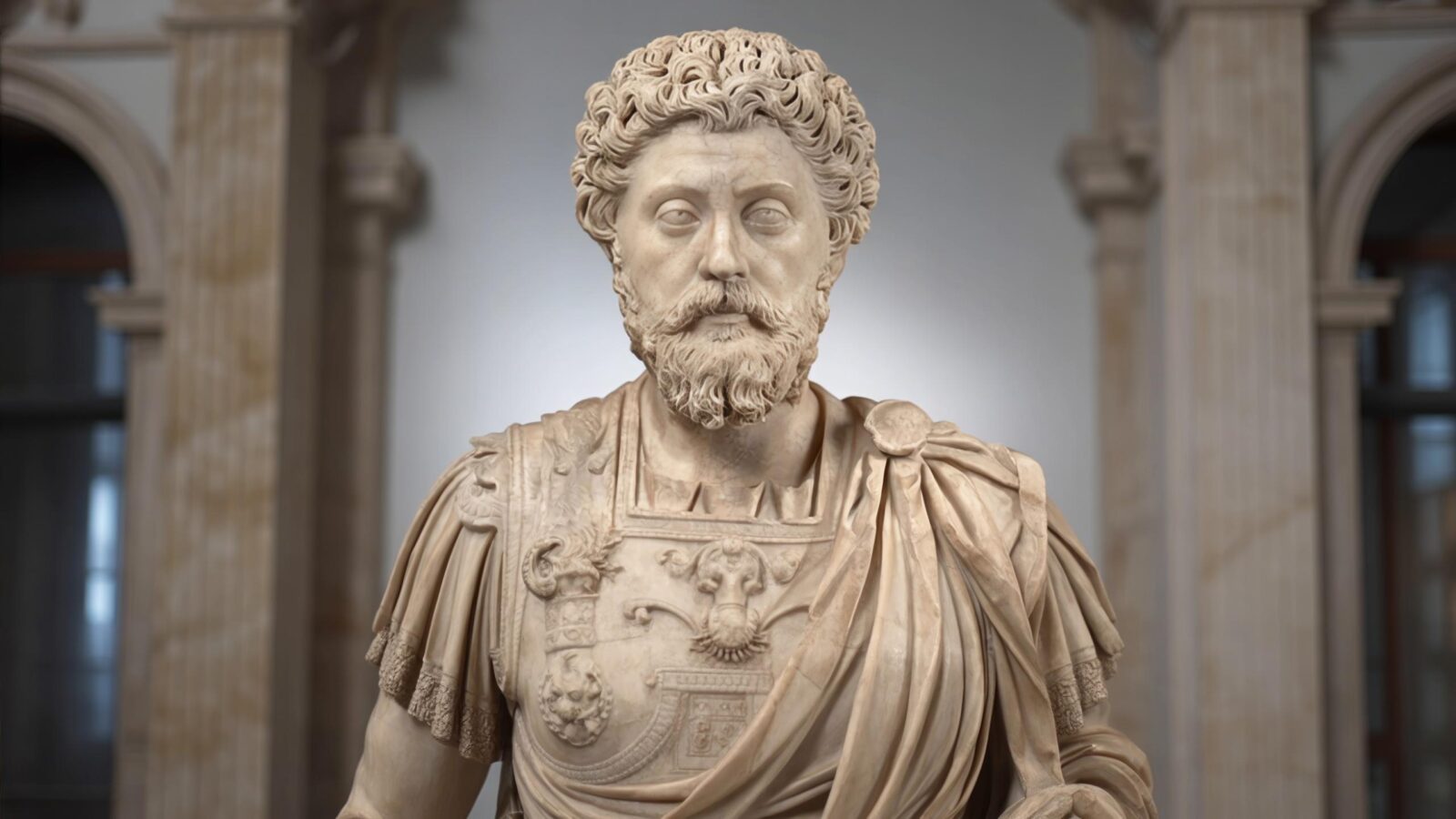
Emperor Marcus Aurelius ruled the Roman Empire while fighting long wars on the northern frontier and enduring a plague that swept across the provinces. In whatever quiet hours he could find, he wrote notes to himself in Greek.
Those notes became Meditations. He never meant for anyone else to read them, which is part of why they feel so honest.
What you will find in his writings is a man who saw weakness of mind as something we do to ourselves, a habit of handing our reason over to whatever chaos happens to be outside the door.
The Stoics measured strength by self-mastery. Here are five habits Marcus warned against, in his own words as translated by George Long, and the fixes he prescribed.
1. Surrendering Control to External Circumstances
A traffic jam. A cold rain on the day of the cookout. A coworker who answers your long email with one word. For a weak mind, any of these can wreck an entire day. The event gets the blame, and the person never looks at their own reaction.
Marcus Aurelius thought this had things backward. In Book 4, he wrote that “our perturbations come only from the opinion which is within.”
He came back to the idea in Book 8 and made it personal. “If thou art pained by any external thing, it is not this thing that disturbs thee, but thine own judgment about it. And it is in thy power to wipe out this judgment now.”
You’ll see a modern line credited to him all over social media: “You have power over your mind, not outside events.” It’s a decent summary of his thinking, though those exact words don’t appear in any translation of Meditations.
The working tool here is the dichotomy of control. Sort every problem into two piles, the things you can act on and the things you can’t, and spend your energy on the first pile only.
2. Complaining and Playing the Victim
Some people treat every obstacle like a personal attack. Hardship becomes the story they tell, over and over, to anyone who will listen. Complaining feels productive. It isn’t, because the energy spent describing a problem is energy you no longer have for fixing it.
Marcus handled this with simple logic in Book 10. “If then it happens to thee in such a way as thou art formed by nature to bear it, do not complain, but bear it as thou art formed by nature to bear it.”
He traced the complaint back to its source in Book 4. “Take away thy opinion, and then there is taken away the complaint, ‘I have been harmed.’ Take away the complaint, ‘I have been harmed,’ and the harm is taken away.”
Nietzsche later gave this attitude a name, amor fati, or love of fate. Marcus never used the phrase, but he lived by the idea and argued that obstacles could be put to work. In Book 5, he wrote that “that which is an obstacle on the road helps us on this road.”
3. Seeking External Validation and Obsessing Over Others’ Opinions
Checking how many people liked your post. Replaying a stranger’s criticism at 2 a.m. Both habits grow from the same root.
When your mood depends on what others think, you’ve given strangers the keys to your peace of mind. Marcus found it odd how often people did this to themselves.
His observation in Book 12 still lands almost two thousand years later. “I have often wondered how it is that every man loves himself more than all the rest of men, but yet sets less value on his own opinion of himself than on the opinion of others.”
His answer was to find the standard inside. In Book 7, he wrote, “Look within. Within is the fountain of good, and it will ever bubble up, if thou wilt ever dig.”
The French scholar Pierre Hadot described this part of Marcus’s thinking as an “inner citadel.” Praise and criticism hit the outer walls of that fortress. Your values and daily conduct stay inside, where no one else can reach them.
4. Letting Uncontrolled Emotions Dictate Actions
Anger makes decisions fast. That’s the problem with it. A snap reply to a minor insult or a resignation letter written in a fury usually costs more than whatever set it off. Most people learn this the expensive way.
Marcus learned it the hard way, too. In 175 AD, one of his own generals, Avidius Cassius, declared himself emperor, and in Book 11, Marcus wrote, “How much more grievous are the consequences of anger than the causes of it.”
The Stoics believe that most destructive emotions begin with a hasty judgment. Slow the judgment down, and the emotion has less to feed on.
In practice, that means building a gap between what happens and what you do about it. Count to five before you speak. Reread the angry email tomorrow morning before you hit send, and you’ll delete it more often than not.
5. Resisting the Present Moment and Avoiding Duty
Procrastination looks harmless. So does daydreaming about the good old days, or lying awake worrying about next year. Each one dodges the only work you can actually do today. Marcus fought this habit personally and wasn’t shy about admitting it.
Book 5 opens with an emperor trying to talk himself out of bed. “In the morning, when thou risest unwillingly, let this thought be present: I am rising to the work of a human being.”
A few lines later, he pushes himself harder. “Or have I been made for this, to lie in the bedclothes and keep myself warm?”
In Book 2, he pointed out that “the present is the only thing of which a man can be deprived.” The past is already gone, and the future isn’t yours yet, so today’s task is the one worth your attention.
Conclusion
Marcus held more power than anyone else in the Roman world. His private notes barely mention it. What fills those pages is a man correcting his mental errors, catching his complaint, his temper, and his urge to stay under the blankets on a cold morning.
He clearly didn’t see weakness as a fixed trait, and he kept working on his own until the end of his life. Pick one of these five habits and work on it this week.