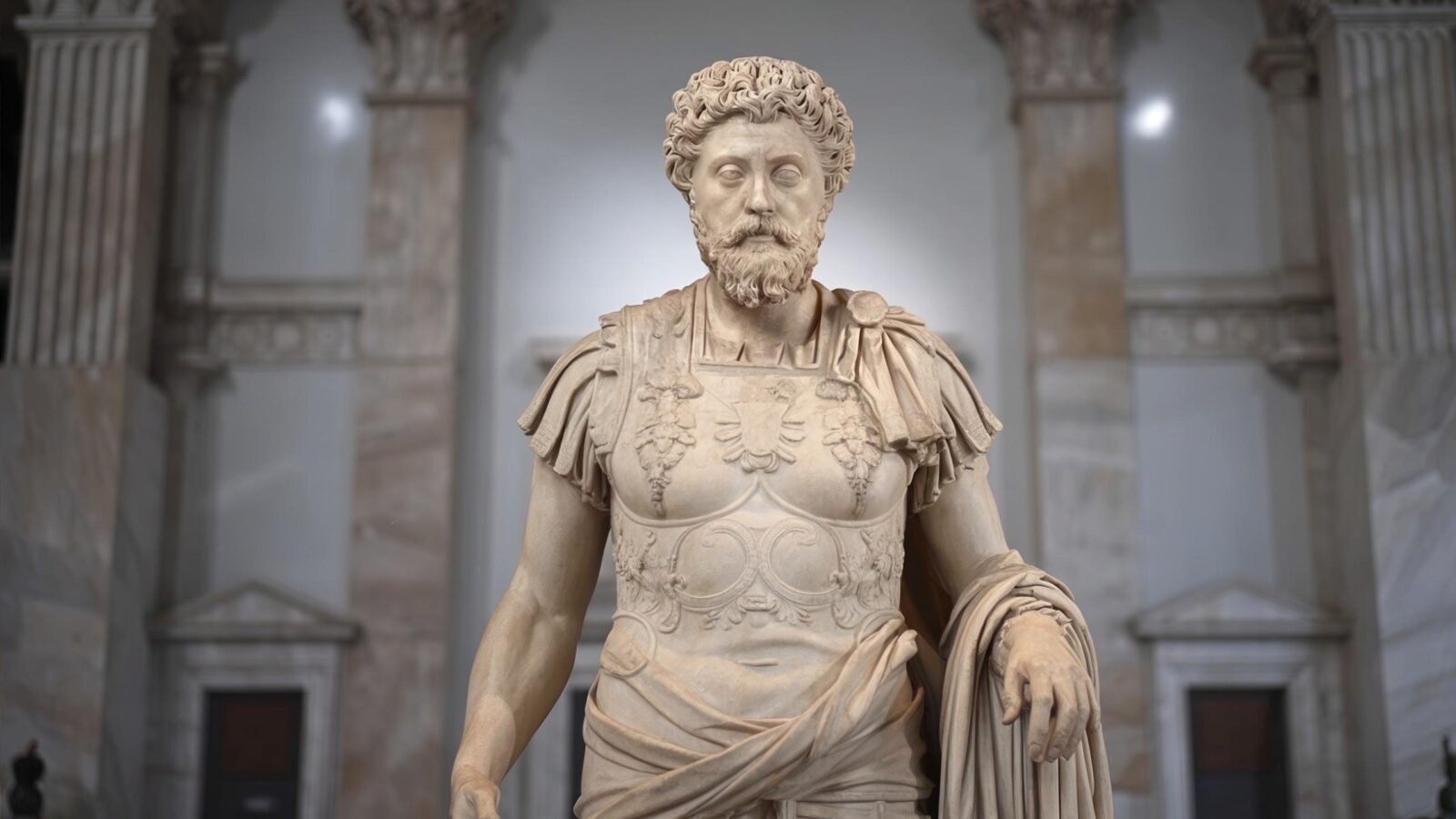
Marcus Aurelius ruled Rome from 161 to 180 AD. He spent those years surrounded by generals, senators, lawyers, and a steady line of people who wanted something from him, yet the man under the purple robe preferred quiet and long hours alone with his thoughts.
He kept a private journal written in Greek. We call it Meditations today, though he never meant for anyone else to read it, and parts of it were written in army camps during his wars along the Danube.
Introverts often feel like the world was built for someone more outgoing with people. The emperor saw things differently, and five of his ideas apply directly to people who would rather think first and talk second.
1. Build an Inner Citadel
Most people picture escaping to a place. A cabin in the hills, maybe, or a beach house with no cell signal.
Marcus Aurelius felt that pull too. He decided the habit was a little silly, noting that “it is in thy power whenever thou shalt choose to retire into thyself.”
A few lines later in the same passage, he went further. “For nowhere either with more quiet or more freedom from trouble does a man retire than into his own soul,” Marcus Aurelius wrote.
This matters for introverts because the cabin is rarely available. You’re stuck at a conference, a wedding reception, or an open-plan office with a coworker who narrates his lunch, and leaving isn’t an option.
Marcus offered a different exit. He compared a calm mind to a fortress, writing,g “The mind which is free from passions is a citadel, for man has nothing more secure to which he can fly for refuge.”
Building that inner mental fortress takes practice. Some people take a few slow breaths in the car before walking into a crowded room. Others keep a short written routine each morning, the way Marcus did, so they have something steady to return to when the noise starts.
2. Protect Your Social Energy
Marcus hated waste. He complained in Meditations about lost hours and idle chatter, and he gave himself a blunt test to cut both down.
The test is a single question. Marcus Aurelius advised that “on every occasion a man should ask himself, Is this one of the unnecessary things?”
He applied the question to thoughts as well as actions. If you stop entertaining pointless worries, he reasoned, pointless behavior tends to drop away on its own.
Introverts have a real limit on how much social contact they can handle in a day. A half-hour call that could have been an email costs more than half an hour, because the recovery afterward counts too.
So run his question before you say yes to anything. Before accepting the dinner invitation or the optional happy hour, ask yourself whether you would actually miss it. Turning things down feels rude at first. Most of the time, nobody minds, and when you show up to the necessary things you need to go to, you have energy to spare.
3. Accept Human Nature Without Frustration
Running an empire meant dealing with difficult people every single day. Marcus put up with flatterers and plotters, and in 175 AD, one of his most trusted generals, Avidius Cassius, declared himself emperor after false reports spread that Marcus had died.
He prepared for these encounters before breakfast. Marcus Aurelius wrote, “Begin the morning by saying to thyself, I shall meet with the busybody, the ungrateful, arrogant, deceitful, envious, unsocial. All these things happen to them by reason of their ignorance of what is good and evil.”
He then explained why none of it should make him angry. “But I, who have seen the nature of the good that it is beautiful, and of the bad that it is ugly, and the nature of him who does wrong, that it is akin to me, not only of the same blood or seed, but that it participates in the same intelligence and the same portion of the divinity, I can neither be injured by any of them, for no one can fix on me what is ugly, nor can I be angry with my kinsman, nor hate him. For we are made for co-operation, like feet, like hands, like eyelids, like the rows of the upper and lower teeth.”
Introverts tend to replay irritating conversations for hours. The rude cashier or the coworker who interrupts every meeting takes up space in your head long after they’ve forgotten you exist.
Expecting that behavior in advance takes some of the sting out of it. You still notice it, but it lands as something predictable instead of a personal insult, and you keep more energy for the people you actually like.
4. Prioritize Quality Over Visibility
Plenty of workplaces reward whoever talks the most in meetings. Marcus had little patience for the idea that praise gives anything its worth.
“Everything which is in any way beautiful is beautiful in itself, and terminates in itself, not having praise as part of itself,” wrote Marcus Aurelius. In the same passage, he asked whether an emerald gets any worse just because nobody praises it.
He added a second line that introverts can keep in their back pocket. “Neither worse nor better is a thing made by being praised.”
Think of the quiet employee who would rather do careful work than sell herself on LinkedIn. The report she checked twice, or the code she cleaned up, has value whether or not anyone mentions it at the next staff meeting.
5. Practice Purposeful Silence
Marcus was wary of talking to fill space. He listed it among the habits he wanted to avoid, telling himself to “be not either a man of many words, or busy about too many things.”
He also preferred plain speech to performance. “Speak both in the senate and to every man, whoever he may be, appropriately, not with any affectation: use plain discourse,” the emperor wrote.
Introverts usually do this by instinct. They listen for a while, then say one useful thing while the others are still warming up.
Other people sometimes read that as shyness or a lack of confidence. Marcus treated restraint in speech as a form of self-control, and people around him tend to lean in when he finally does speak.
The next time a meeting goes silent, let it stay that way for a moment. Someone else might say the thing that needed saying, or your own comment might come out sharper for the wait.
Conclusion
Marcus Aurelius held one of the most stressful jobs in the ancient world and still kept his inner life intact. He did it with small daily habits that anyone can borrow nearly two thousand years later.
Pick one idea from this list and try it this week. Ask whether the next invitation is necessary, or take five quiet minutes alone in your car before a crowded event.
You don’t have to turn yourself into an extrovert to do well. The emperor managed fine as an introvert at the head of an empire, and his private journal is still in print for anyone who wants to read the rest of it.