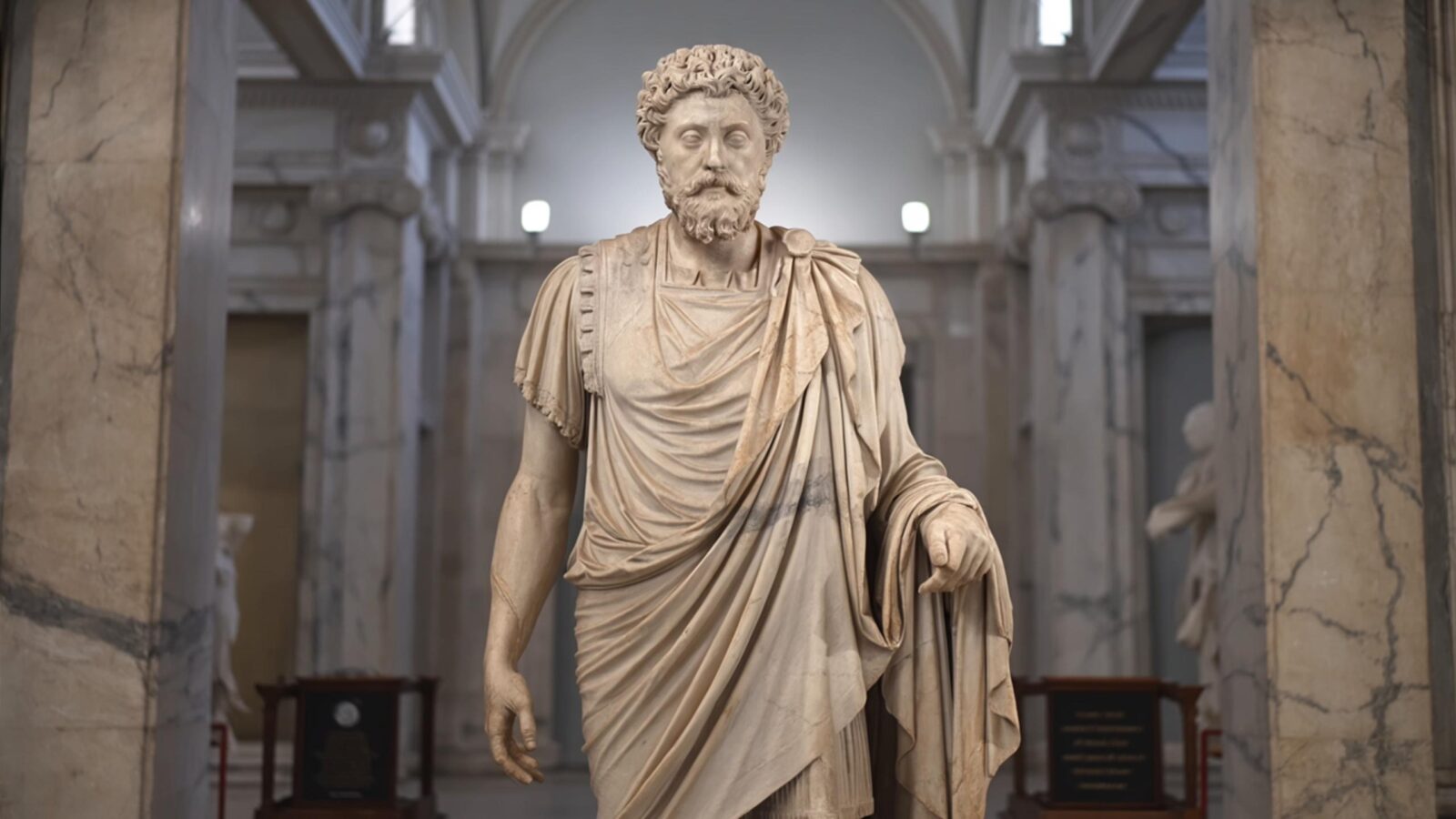
Marcus Aurelius wrote Meditations for himself, not for an audience. His personal journal reads like the working pages of a ruler who kept returning to certain authors when grief, anger, vanity, fatigue, or fear threatened to take over.
Marcus Aurelius was emperor of Rome, yet he spent little time in those pages celebrating power. He quoted teachers, poets, playwrights, and philosophers because their words gave him a way to examine his conduct before the day got away from him. His reading was practical. A line worth keeping had to help him meet trouble without becoming petty, cruel, or self-important.
1. Epictetus Gave Aurelius His Daily Discipline
Epictetus was the strongest single influence on Marcus Aurelius. In Book 1 of Meditations, Marcus credits Quintus Junius Rusticus with introducing him to Epictetus’s lectures and lending him a copy. Rusticus was a Roman senator and Stoic teacher whose example mattered as much as the books he shared.
Epictetus was born into servitude and later taught philosophy in Greece. His central lesson was plain: people do not command events, other people’s behavior, illness, reputation, or death. They do command their judgments, choices, and willingness to do the right thing.
Marcus Aurelius turned that distinction over again and again. A ruler could issue orders, but he could not force the world to cooperate. By focusing on judgment and duty, he had firm ground to stand on when an army faltered, a courtier lied, or public approval shifted.
2. The Early Stoics Supplied the School’s Core Ideas
Zeno of Citium founded Stoicism, and Cleanthes and Chrysippus developed it after him. Their writings taught that the good life depends on virtue rather than wealth, comfort, public rank, or luck. Marcus absorbed that hierarchy of values so deeply that it became the source behind much of Meditations.
Stoics spoke of living according to Nature. For Marcus, this meant acting in line with human reason and with the fact that people must work together in harmony. He saw fairness as an obligation, even when the person in front of him was difficult or disappointing.
Chrysippus also helped shape the Stoic account of logic and the ordered cosmos. Marcus did not write technical arguments about those subjects. Still, he often treated the world as a whole governed by reason and urged himself to accept his place within it without abandoning his moral responsibilities.
3. Heraclitus Made Change Easier to Face
Marcus frequently turned to Heraclitus, the Greek philosopher associated with change. Heraclitus saw the world as a place of motion where nothing stays fixed for long. That idea was useful to a man living through warfare and plague, with death never far from the imperial household.
Meditations often turn to the short life of praise, ambition, and political fame. Marcus did not need a grand theory to see that an admired leader could be forgotten within a few generations. The point was not despair. It was to stop spending mental energy on things that vanish quickly.
Heraclitus also helped him cope with personal loss. Bodies change, families pass away, and public fortunes reverse. Marcus wanted to see those facts clearly enough that he could grieve without turning grief into a complaint against the order of life.
4. Plato and Socrates Set a Standard for Character
Marcus knew Plato’s dialogues and held Socrates in high regard. Socrates offered an example of someone who would endure hardship rather than betray his principles. In Plato’s Apology, Socrates refuses to abandon what he sees as his proper duty merely because danger stands in the way.
That image fit Marcus’s own position. His life as emperor required choices that could not be avoided by retreating into private comfort. He looked to philosophy for a standard higher than popularity, which was useful in a political world full of flatterers and rivals.
Platonic writing also encouraged a wider view of human affairs. Marcus tells himself to look down on cities, ceremonies, battles, and private quarrels as parts of a vast human scene. Seen at that distance, a slight from a neighbor or a hostile remark at court loses much of its power.
5. He Learned From Rival Philosophies Without Abandoning Stoicism
Marcus did not avoid writers who disagreed with the Stoics. He engaged with Epicurean thought, especially regarding pain and death, and mentioned the atomism associated with Epicurus and Democritus. He rejected their account of a world made only of atoms moving without providence, yet he could still find a useful observation in a rival school.
Epicurus, for example, offered advice about bearing pain without adding needless panic. Marcus could borrow that practical insight while holding a different view of the cosmos. His method was selective and demanding. A good sentence had to survive contact with real life.
He sometimes frames the world in two possible ways: a rational providence or atoms. In either case, he tells himself to behave decently. If the world has order, justice belongs within it. If it does not, a person still has no better rule than sound judgment and service to others.
6. Poets, Playwrights, and Roman Mentors Kept Him Honest
Marcus drew on Homer, Greek drama, and philosophy. Homer gave him images of mortality, including the comparison between generations of people and leaves that appear and fall. Euripides and other tragedians gave him lines about fate and the need to carry one’s assigned part without theatrical complaint.
Comedy had its place too. Marcus referred to Aristophanes and Menander, writers whose work exposed vanity and hypocrisy in public life. An emperor had a special reason to value any art that could puncture self-importance.
His teacher, Fronto, had trained him in rhetoric and Latin literature, and their surviving letters show affection on both sides. Marcus later pulled away from ornamental language and the desire to impress. Rusticus pushed him toward plain speech and personal correction, which explains why Meditations often sounds more like a stern private note than a polished public work.
Conclusion
Marcus Aurelius read in order to live better under pressure. Epictetus gave him a discipline of judgment, the early Stoics gave him an ethical foundation, Heraclitus kept change in view, and Socrates showed him what principle could cost. The result was a personal notebook written by an emperor who knew that authority over other people was far less important than authority over his own conduct.