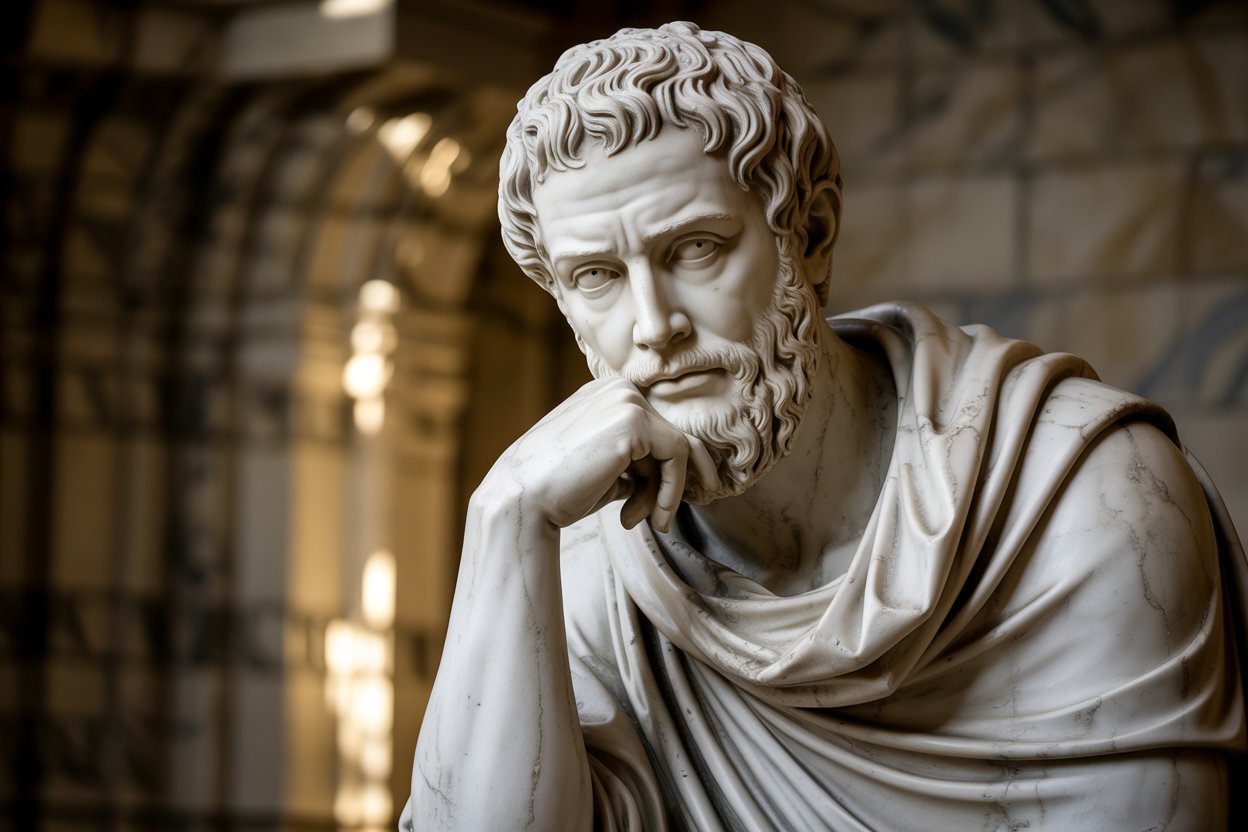
In this article, ancient philosophy meets modern neuroscience in a framework that transforms how you think, make decisions, and achieve success. Stoicism has endured for 2,000 years because it works, and contemporary research continues to validate what Marcus Aurelius, Epictetus, and Seneca discovered through their own lived experiences.
These five daily habits require no special equipment, no financial investment, and no complicated systems. They demand only consistency and the willingness to think clearly about what actually matters.
1. Morning Premeditation (Negative Visualization)
The Stoics began each day by anticipating obstacles before encountering them. This wasn’t pessimism but preparation. Marcus Aurelius wrote in his Meditations, “Begin the morning by saying to thyself, I shall meet with the busybody, the ungrateful, arrogant, deceitful, envious, unsocial.” By mentally rehearsing challenges, you remove the element of surprise that triggers poor decisions.
Cognitive Behavioral Therapy research demonstrates that pre-experiencing potential stressors reduces physiological stress responses when those situations actually occur. Your brain treats mental rehearsal similarly to real experience, building neural pathways that facilitate calmer reactions in high-pressure situations.
This isn’t imagination run wild, but controlled scenario planning. You envision the difficult client, the market downturn, and the unexpected expense, and you script your response in advance.
The outcome is measurable. People who practice morning premeditation report greater emotional control during actual crises, fewer impulsive reactions to unexpected events, and higher overall resilience when facing sustained pressure. The practice takes five minutes but compounds throughout the day as each anticipated challenge arrives with a pre-built response ready for deployment.
2. Focus Only on What You Control
Epictetus opened his Enchiridion with perhaps the most practical observation in Western philosophy: “Some things are in our control and others not.” This single distinction separates productive effort from wasted energy. You control your actions, your interpretations, and your responses. You don’t control markets, other people’s decisions, or external events. Anxiety lives in the gap between these categories.
Research on locus of control indicates that individuals who focus their mental energy on controllable factors tend to experience lower anxiety levels, higher achievement rates, and better decision-making accuracy.
The mechanism is straightforward. When you stop ruminating about uncontrollable variables, you free cognitive resources for actionable steps. The trader who obsesses over Federal Reserve policy burns mental calories that could go toward position sizing and risk management.
This habit transforms performance across domains. You execute faster because factors outside your influence don’t paralyze you. You sleep better because you aren’t replaying conversations you can’t change.
You build wealth more efficiently because your energy flows toward decisions you can actually make. The practice requires constant vigilance because human brains naturally drift toward worrying about uncontrollables, but the payoff in reduced stress and increased effectiveness justifies the effort.
3. Daily Voluntary Discomfort
Seneca advised choosing discomfort deliberately: “Set aside a certain number of days, during which you shall be content with the scantiest and cheapest fare.”
The Stoics understood what modern science refers to as hormesis, the principle that mild stressors strengthen systems rather than weaken them. Cold showers, intermittent fasting, and voluntary restraint from small pleasures all train the same neural circuits that determine self-control in high-stakes situations.
Research on hormesis demonstrates that controlled exposure to mild stress improves resilience markers, enhances discipline capacity, and regulates dopamine sensitivity. Your brain can’t distinguish between resisting the urge to check your phone and resisting the urge to panic-sell during a market correction. Both draw from the same pool of self-regulatory resources, and both improve with practice.
The outcomes extend beyond mere tolerance. People who practice voluntary discomfort report higher stress tolerance during unavoidable difficulties, greater self-mastery in tempting situations, and improved ability to delay gratification for larger future rewards.
The practice doesn’t require extreme measures. Skip breakfast once weekly. Take cold showers. Sit with boredom instead of reaching for entertainment. Minor discomforts compound into significant capacity over time.
4. Evening Self-Reflection
The Stoics closed each day with a structured review. Epictetus prescribed a specific practice: “Allow not sleep to close your wearied eyes, until you have reckoned up each daytime deed.” This wasn’t guilt-driven self-criticism but honest assessment. What went well? What failed? What could improve? The questions create feedback loops that accelerate learning.
Reflective journaling research consistently shows that people who review their days systematically demonstrate improved emotional intelligence, better learning retention, and higher rates of goal achievement.
The mechanism involves consolidating experiences into patterns, identifying recurring mistakes before they become habits, and extracting lessons while memory remains fresh. Without reflection, experiences pass by without being fully integrated.
The compounding effects appear gradually but powerfully. You stop repeating the same errors because you’ve identified them and scripted alternatives. You learn faster because you’re actively processing experiences rather than just accumulating them.
You grow more self-aware because you’re examining your actual behavior against your stated values. The practice requires fifteen minutes of honest writing, but those minutes generate returns measured in years of avoided mistakes.
5. Gratitude for the Present Moment
Epictetus captured the essence of sustainable contentment: “He is a wise man who does not grieve for the things which he has not, but rejoices for those which he has.” This wasn’t empty positive thinking but a deliberate shift in attention.
You already possess resources worth appreciating. Health, relationships, fundamental security, and the ability to read these words all represent conditions that most humans throughout history have never enjoyed.
Research on gratitude practices links daily appreciation exercises to measurably higher happiness levels, improved sleep quality, and stronger relationship satisfaction.
The neurological mechanism involves shifting attention from deficit scanning to abundance recognition. Your brain’s negativity bias evolved to detect threats, but it struggles to distinguish between genuine dangers and imaginary ones. Gratitude interrupts this pattern.
The practical outcome is contentment without complacency. You appreciate what you have while still working toward what you want. You reduce hedonic adaptation by actively noticing existing good rather than constantly seeking new stimulation.
You build resilience because your baseline satisfaction doesn’t depend entirely on external achievements. The practice takes three minutes of listing specific things you currently possess and appreciate, but those minutes recalibrate your entire orientation toward life.
Conclusion
Stoicism endures because it targets the exact mechanisms modern science identifies as foundational to human performance and satisfaction. These habits train attention, emotion regulation, and behavioral consistency through daily repetition.
They require no exceptional circumstances, no expensive tools, and no complex systems. They demand only the discipline to practice consistently and the honesty to assess results.
The compound effects appear slowly but inevitably. Minor improvements in emotional control, decision-making, and stress tolerance accumulate into substantial advantages over time. You can’t control external outcomes, but you can control these five daily practices. That makes them worth doing.