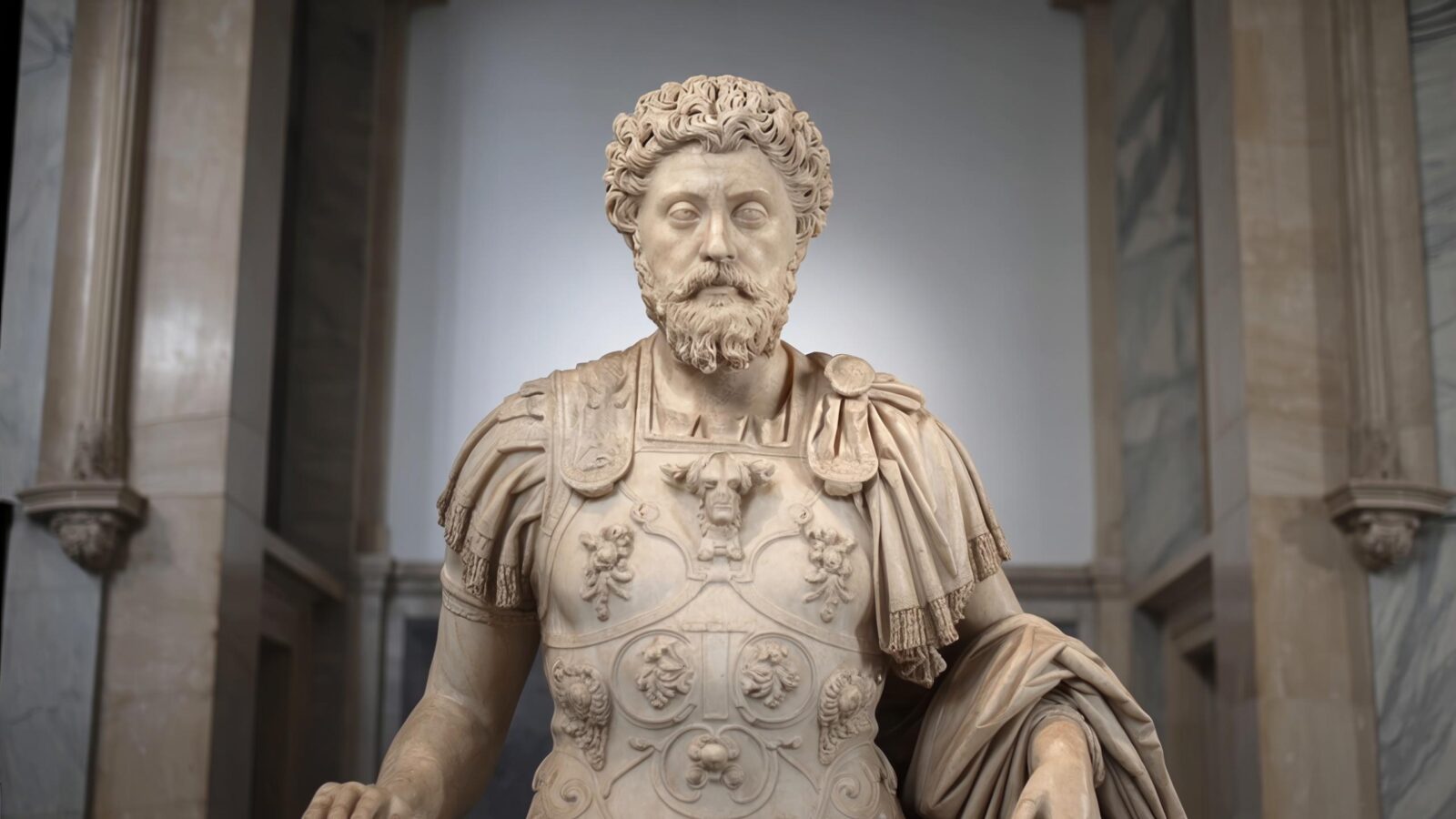
Marcus Aurelius ran the Roman Empire from 161 to 180 AD. He spent those years fighting frontier wars and dealing with a plague, and he still found time to write private notes to himself.
Those notes became Meditations. He never meant anyone else to read them, which is why they’re so personal and direct. Every quote below comes from a translation of Marcus Aurelius’ own words. Here are 10 Stoic self-discipline principles Marcus Aurelius lived by.
1. Control Your Internal Perception (Mental Self-Discipline)
Someone cuts you off in traffic. Your stock gaps down at the open, and neither event gets a say in how you feel unless you hand over that power.
In Book 4.7, Marcus Aurelius put it bluntly: “Take away thy opinion, and then there is taken away the complaint, ‘I have been harmed.’ Take away the complaint, ‘I have been harmed,’ and the harm is taken away.” The damage happens in the story you tell yourself afterward.
Start small with this one. The next time a minor annoyance hits, describe the event in plain words before you react and notice how much of the sting was your own commentary.
2. Overcome Resistance and Take Action
One of the most powerful men in history struggled to get out of bed. He wrote about it more than once.
In Book 5.1, Marcus Aurelius coached himself: “In the morning when thou risest unwillingly, let this thought be present—I am rising to the work of a human being. Why then am I dissatisfied if I am going to do the things for which I exist and for which I was brought into the world? Or have I been made for this, to lie in the bedclothes and keep myself warm?—But this is more pleasant.—Dost thou exist then to take thy pleasure, and not at all for action or exertion? Dost thou not see the little plants, the little birds, the ants, the spiders, the bees working together to put in order their several parts of the universe? And art thou unwilling to do the work of a human being, and dost thou not make haste to do that which is according to thy nature?”
He didn’t wait for motivation to show up. He got up because the job needed doing, and the mood could catch up later or not at all.
3. Focus Sharply on the Present Moment
Distraction was a problem long before smartphones. Marcus dealt with endless petitions, court cases, and military reports.
His fix was to treat each task as if it were his final one. Marcus Aurelius told himself in Book 2.5 to do “every act of thy life as if it were the last” and to drop the carelessness that creeps in when we assume there’s always a next time.
That framing changes how you work. You don’t half-finish the last thing you’ll ever do.
4. Practice Mindful Self-Awareness
Your mind keeps running whether you steer it or not. Left alone, it drifts toward old grudges and worst-case scenarios.
Marcus Aurelius warned in Book 5.16, “Such as are thy habitual thoughts, such also will be the character of thy mind.” He followed that with a striking image, writing that “the soul is dyed by the thoughts.”
Picture a piece of cloth sitting in a vat of dye for years. The color soaks all the way through, and your character takes on the shade of your thoughts over thousands of ordinary days.
5. Turn Obstacles into Fuel
Plans fall apart. A deal collapses, or a health problem knocks you off your routine for a month.
Marcus believed a trained mind could repurpose almost any setback. In Book 5.20, Marcus Aurelius wrote that “that which is an obstacle on the road helps us on this road.” A setback might stop one specific action. It can’t stop you from responding patiently or with a smarter plan.
Ryan Holiday built a whole book, The Obstacle Is the Way, around this idea. It may be the most practical passage in Meditations.
6. Reject the Need for External Validation
Chasing approval puts other people in charge of your behavior. Marcus wanted his actions anchored to something steadier than applause.
Marcus Aurelius argued in Book 4.20, “Everything which is in any way beautiful is beautiful in itself, and terminates in itself, not having praise as part of itself.” He went on to ask whether an emerald gets worse because nobody compliments it.
Good work keeps its value in an empty room. That holds whether you’re raising kids or quietly paying down debt with nobody cheering.
7. Master Emotional Impulse
Anger feels powerful in the moment. It usually costs more than whatever caused it.
Marcus Aurelius made this point in Book 11.18: “Consider how much more pain is brought on us by the anger and vexation caused by such acts than by the acts themselves, at which we are angry and vexed.” A rude email takes ten seconds to read. The fuming can eat up a whole afternoon.
Putting a pause between the trigger and your response is a skill you can build. Take a walk or sleep on it before you hit send.
8. Keep Impermanence in Mind (Memento Mori)
Thinking about death sounds morbid. For Marcus Aurelius, it worked as a filter that sorted out what actually deserved his time.
Marcus Aurelius wrote in Book 2.11 that “it is possible that thou mayest depart from life this very moment” and told himself to shape every act and thought around that fact. Petty arguments look pretty small next to that sentence.
He lost several of his children young, so this wasn’t abstract for him. Death was a daily fact in second-century Rome, even inside the palace walls.
9. Fulfill Your Social Duty and Serve Others
Some people treat self-discipline as a private project. Marcus saw it as part of his obligation to everyone around him.
Marcus Aurelius summed it up in Book 6.54: “That which is not good for the swarm, neither is it good for the bee.” A habit that wrecks your family or your team will eventually wreck you, too.
The Stoics believed humans were built for cooperation. Your discipline shows up in how dependable you are for the people who count on you.
10. Accept Circumstances with Grace (Amor Fati)
Fighting reality wears you out. For example, the market does what it does, and complaining about it has never moved a single price.
Marcus compared a strong mind to a big fire. A small flame gets smothered by whatever falls on it, but a strong one burns the new fuel and, in the words of Marcus Aurelius from Book 4.1, “A blazing fire makes flame and brightness out of everything that is thrown into it.”
The phrase amor fati actually comes from Friedrich Nietzsche, centuries later. Marcus never used it, though his writing carries the same attitude of working with whatever you’re handed.
Conclusion
Marcus Aurelius held more power than nearly anyone alive in his era. His journal shows him spending most of his effort trying to govern one person, himself.
None of these ideas require a palace or a philosophy degree. Pick one principle, try it for a week, and pay attention to what changes.