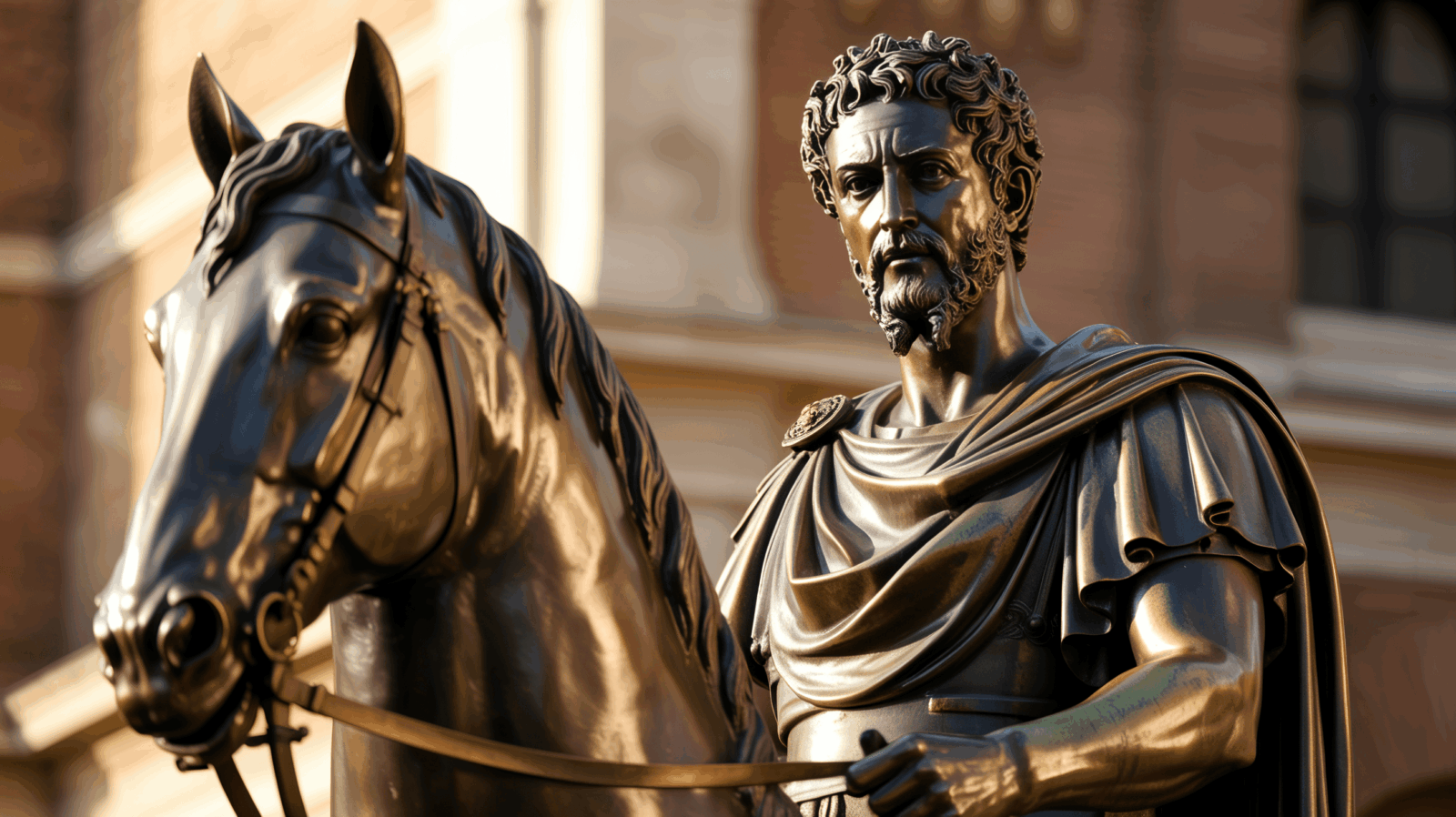
Marcus Aurelius ruled the Roman Empire at its peak, commanded armies, and navigated political betrayal—yet his most enduring legacy is a private journal he never intended to publish. Meditations is a record of a man forcing himself to see clearly, regardless of how uncomfortable that clarity might be.
The truths inside that journal aren’t comfortable. Most men encounter them only after paying a steep price: wasted years, broken relationships, or a missed purpose in life. Here are ten hard Stoic lessons worth learning now.
1. You Don’t Have as Much Time as You Think
“You could leave life right now. Let that determine what you do and say and think.” — Marcus Aurelius.
Most men operate as though time is a resource that replenishes itself. They defer difficult conversations, meaningful work, and purposeful living to some future version of themselves who never quite arrives.
The Stoic position is blunt: mortality isn’t a distant event. It is the condition under which every decision is made. Treating each day as borrowed time doesn’t create anxiety; it eliminates the low-grade paralysis of indefinite postponement.
2. Other People’s Opinions Are Meaningless
“I have often wondered how it is that every man loves himself more than all the rest of men, but yet sets less value on his own opinion of himself than on the opinion of others.” — Marcus Aurelius.
The approval trap is subtle. A man can spend decades building a life that looks impressive from the outside while feeling hollow on the inside, having quietly traded his own judgment for someone else’s applause.
Marcus Aurelius noticed this contradiction in himself and called it out directly. External validation is borrowed confidence. The only opinion that compounds in your favor over time is the one you hold about your own integrity.
3. Comfort Weakens You
“If it is not right, do not do it; if it is not true, do not say it.” — Marcus Aurelius.
Discipline feels hard in the moment, but the cost of avoiding it is a life shaped by drift rather than direction. Comfort chosen repeatedly becomes a ceiling, not a floor.
The Stoics understood that the desire to avoid difficulty is one of the most reliable ways to create it later. Every shortcut taken today is a debt that will be collected at a much higher interest rate down the road.
4. You Control Less Than You Think
“You have power over your mind—not outside events. Realize this, and you will find strength.” — Marcus Aurelius.
The attempt to control outcomes, other people, and circumstances creates a specific kind of exhaustion. It burns energy on things that were never within reach to begin with.
Stoic philosophy doesn’t teach passivity. It teaches precision. Redirect the effort spent trying to manage the uncontrollable toward mastering your own response, and you recover an enormous amount of power that was previously being wasted.
5. Your Habits Are Your Destiny
“Such as are your habitual thoughts, such also will be the character of your mind.” — Marcus Aurelius.
Identity isn’t declared. It’s constructed, one repeated action at a time. The man who says he values discipline but avoids discomfort daily is not disciplined, regardless of what he believes about himself.
What you do habitually is what you are becoming. The gap between who a man thinks he is and who he actually is is either closing or widening, depending on what he does when no one is watching.
6. Death Makes Everything Urgent
“Do not act as if you were going to live ten thousand years.” — Marcus Aurelius.
Procrastination is rarely about laziness. More often, it is a quiet refusal to acknowledge that time is finite and that inaction carries the same consequences as a wrong decision.
Awareness of death doesn’t produce despair in Stoic thinking; it produces clarity. When a man genuinely accepts that his time is limited, trivial concerns lose their grip and essential ones come into sharp focus.
7. Anger Always Costs You More Than the Offense
“The best revenge is not to be like your enemy.” — Marcus Aurelius.
Uncontrolled anger feels justified in the moment. It rarely is. The emotional energy burned, the relationships damaged, and the reputation undermined by reactive behavior nearly always exceed whatever provoked the response in the first place.
Emotional mastery isn’t suppression. It’s the recognition that you can’t afford to let someone else’s poor behavior determine the quality of your own. Losing control is self-sabotage with someone else’s face on it.
8. No One Is Coming to Save You
“Look well into thyself; there is a source of strength which will always spring up if thou wilt always look.” — Marcus Aurelius.
Waiting for the right circumstances, the right mentor, the right opportunity, or the right moment is a comfortable story. It is also a way of outsourcing responsibility indefinitely while calling it patience.
The Stoic tradition places full accountability on the individual, not as a burden but as a liberation. Once a man stops waiting for someone to rescue them, he discovers the resources he needed were internal all along.
9. Most Things You Fear Never Happen
“Today I escaped anxiety. Or no, I discarded it, because it was within me, in my own perceptions.” — Marcus Aurelius.
Anxiety is largely a product of imagination, not circumstance. The mind runs through worst-case scenarios with a confidence it has rarely earned, and a man can exhaust himself fighting threats that exist only in projection.
Marcus Aurelius framed this as a choice, not a condition. The perception that creates the suffering is the same perception that can dissolve it. Fear loses most of its power when it’s examined rather than obeyed.
10. A Good Life Is Simple, But Not Easy
“Very little is needed to make a happy life; it is all within yourself, in your way of thinking.” — Marcus Aurelius.
Men are sold the idea that meaning comes from accumulation: more money, more status, more achievement, more recognition. Marcus Aurelius, who had all of it, pointed in the opposite direction.
Clarity of thought, alignment between values and action, and the daily practice of virtue: these are the actual components of a life well lived. The formula is simple. Applying it consistently, against the pull of comfort and distraction, is the work of a lifetime.
Conclusion
The thread running through every one of these truths is the same: men suffer far more from illusion than from reality. The illusion of unlimited time, the illusion of external control, the illusion that approval from others constitutes a meaningful life.
Marcus Aurelius spent his reign as emperor and his private hours in Meditations, wrestling with these same tendencies in himself. The value of Stoicism isn’t that it makes the work easier. It’s that it makes the right work impossible to ignore.