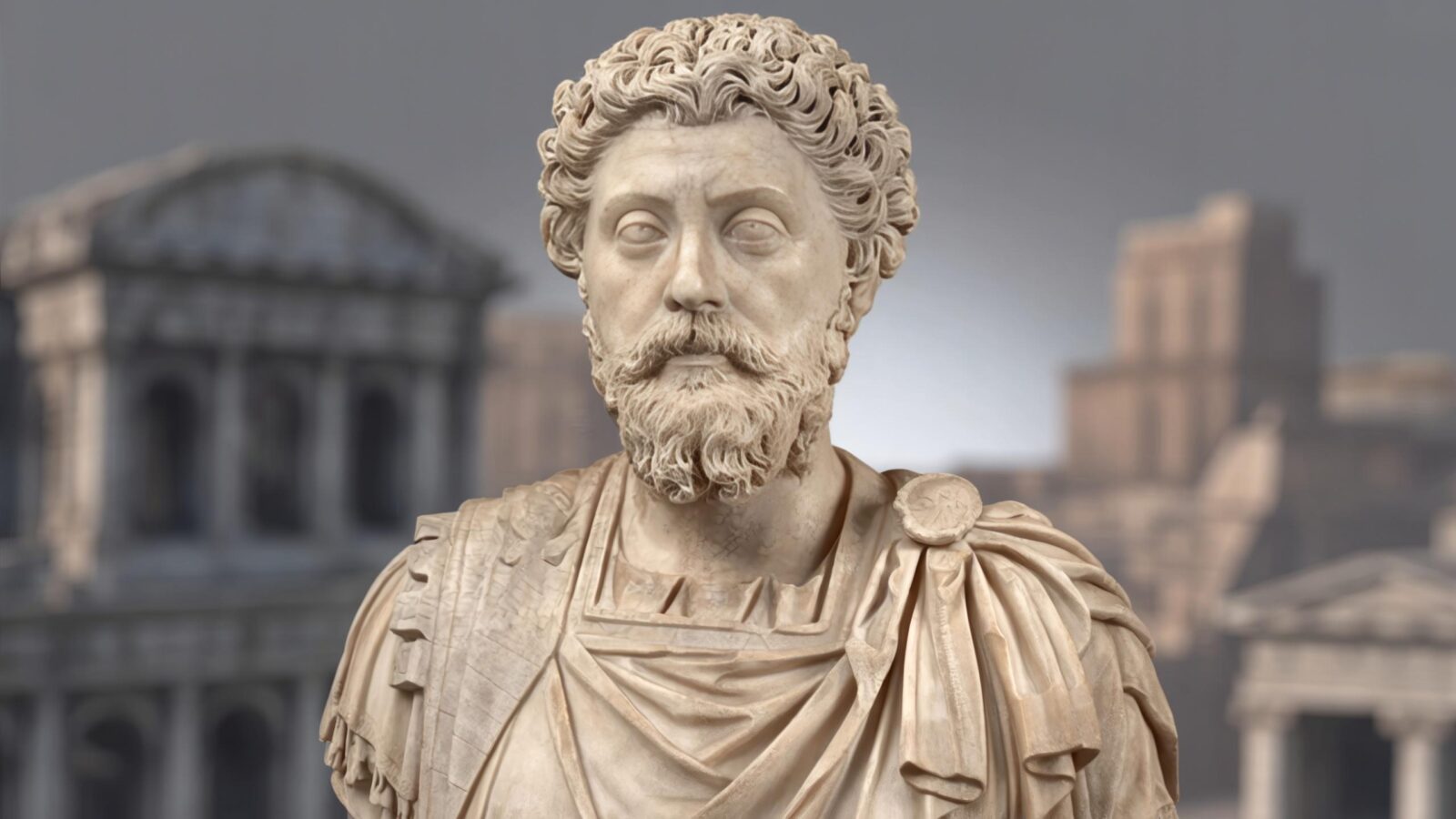
Motivation is a feeling, and feelings are unreliable. It shows up after a good night’s sleep and disappears the moment a task gets boring.
Self-discipline works on different terms. Marcus Aurelius, who ruled Rome from 161 to 180 AD, treated it as a commitment he renewed every day, whether he felt like it or not.
His private notes were later published as Meditations. He wrote many of them during long years of war on the northern frontier while a plague moved through the empire.
Below are five lessons from those notes that can keep you working after your enthusiasm runs out. Each one is backed by the emperor’s own words, as translated by George Long in 1862.
1. Treat the Work as Part of Who You Are
Most people wait to feel ready before they start. Emperor Aurelius had the same problem with getting out of bed, and he wrote himself a blunt reply.
“In the morning, when thou risest unwillingly, let this thought be present: I am rising to the work of a human being. Why then am I dissatisfied if I am going to do the things for which I exist and for which I was brought into the world? Or have I been made for this, to lie in the bedclothes and keep myself warm?” – Marcus Aurelius, Meditations, Book 5.1
It’s a funny admission from a Roman emperor. He clearly lay there some mornings wishing he could stay put, or he wouldn’t have bothered to argue with himself on paper.
His answer was to stop treating the day’s work as optional. Getting up and doing his job was what a human being was for, and staying warm under the covers was a poor substitute.
You can borrow that framing for your own tasks. Swap the question “Do I feel like this?” for “What is my purpose today?”
That second question has an answer even on your worst mornings. The report still needs writing, and the workout still needs doing, whatever your mood happens to be at 6 a.m.
2. Shrink the Task to the Next Step
Large goals can stop you in your tracks when energy is low. Picturing the entire book that needs to be written, or the entire year of training, makes the first step feel pointless.
“Do not disturb thyself by thinking of the whole of thy life. . . but on every occasion ask thyself, What is there in this which is intolerable and past bearing? For thou wilt be ashamed to confess.”
– Marcus Aurelius, Meditations, Book 8.36
Marcus caught his own mind doing this. It would gather every future difficulty into one heap and then complain that the heap was too heavy to lift.
His fix was to look only at the piece in front of him. Taken alone, almost nothing he faced in a single moment was truly beyond bearing, and he admitted he’d be embarrassed to claim otherwise.
Try the same trick when you have trouble getting started; just focus on today’s work in this moment. Write one paragraph and see if you can keep going into a second one, or do a single set of squats and then see if a second set feels possible. Then do it again tomorrow.
3. Argue With Your Own Story
Stoic teaching holds that events and sensations can’t force your hand. What moves you is the opinion you form about them.
“Take away thy opinion, and then there is taken away the complaint, ‘I have been harmed.’ Take away the complaint, ‘I have been harmed,’ and the harm is taken away.”
Marcus Aurelius, Meditations, Book 4.7
Marcus was writing about insults and injuries here, but the logic carries over to fatigue. “I’m too tired to do this” is an opinion stacked on top of a physical sensation.
The tiredness is real, and you don’t have to pretend otherwise. The conclusion you draw from it is a separate step, and that step belongs to you.
Next time the thought “I don’t feel like it” shows up, say it out loud if you have to. Then open the laptop or lace up your shoes while the thought is still sitting there.
4. Use the Resistance as Training
Most of us read low energy as a signal to quit for the day. Marcus looked at obstacles differently and said so plainly.
“. . . The mind converts and changes every hindrance to its activity into an aid. . . and that which is an obstacle on the road helps us on this road.” – Marcus Aurelius, Meditations, Book 5.20
Later writers used the Latin phrase “amor fati”, or “love of fate,” to describe this habit of taking what happens and putting it to use. Nietzsche made the phrase famous many centuries after Marcus died, though the attitude closely fits his notes.
The flat, uninspired afternoons are where discipline actually gets built. Each session you finish without a spark of inspiration is one more rep for the part of you that acts on decisions rather than moods.
Keep a simple log if it helps. A row of checkmarks for the days you showed up feeling lousy gives you hard evidence to look at the next time you want to skip a day’s work.
5. Let a Short Life Speed You Up
The Stoics kept death in view on purpose, a practice often summed up by the Latin phrase memento mori. Marcus used that awareness to cut down on stalling.
“Since it is possible that thou mayest depart from life this very moment, regulate every act and thought accordingly.” – Marcus Aurelius, Meditations, Book 2.11
Some readers find this grim, and it is a little grim. Marcus kept writing lines like it anyway because they got him moving. Waiting for the right mood wastes time you can’t get back. Nobody knows how much of it is left.
A practical version is to ask what you would hate to leave undone this week. Put that task at the top of tomorrow’s list and finish it before you open your email.
Conclusion
Motivation will come and go for as long as you live. Marcus Aurelius dealt with the same problem nearly two thousand years ago, and his notes show him fighting it on ordinary mornings.
You don’t need to adopt all five lessons at once. Pick the one that matches your biggest sticking point and use it on the next task you’ve been putting off.
If getting started is the problem, shrink the task until it looks almost silly. If it’s the voice telling you you’re too tired, treat that voice as an opinion and get to work while it keeps talking.