
Charlie Munger was Warren Buffett’s business partner for decades, and his thinking helped shape the vast operations of Berkshire Hathaway. He had little patience for complicated formulas or for investors who made emotional decisions.
His approach rested on a short list of plain ideas that he stuck with for a very long time, through economic booms and through ugly markets. Here are five of them and how smart people put them to work.
1. Buy High-Quality Businesses at Fair Prices
Early in his career, Buffett bought stocks the way Benjamin Graham taught. He hunted for “cigar butts,” cheap and struggling companies with one last free puff of value left in them.
Munger pushed him in a different direction. He wanted Buffett to pay a fair price for an excellent business rather than a rock-bottom price for a mediocre one, because over decades, the business itself does the heavy lifting.
As Charlie Munger put it, “Over the long term, it’s hard for a stock to earn a much better return than the business which underlies it earns.” A cheap entry price helps for a while. It can’t rescue a company that earns poor returns year after year.
The companies Munger liked could reinvest their profits at high rates and keep doing it for a long time. They usually had something competitors struggled to copy, like a trusted brand or the ability to raise prices without losing customers.
Finding those businesses takes work. Paying a reasonable price for one is usually a better deal than grabbing a bargain tied to a company that’s slowly shrinking.
2. Concentrate on Your Best Ideas
Most financial advice tells you to spread your money across as many holdings as possible. Munger thought that too much diversification mostly guaranteed average results.
Great opportunities don’t show up often. When one did, and the odds were clearly in his favor, he wanted to put real money behind it rather than a token amount.
In his 1994 talk at USC Business School, Charlie Munger said, “The wise ones bet heavily when the world offers them that opportunity. They bet big when they have the odds. And the rest of the time, they don’t. It’s just that simple.” He spent most of his career waiting and a small part of it betting big.
That kind of concentration only makes sense if you’ve done the homework. Owning a handful of businesses you know inside and out is very different from owning a handful you picked randomly off social media.
Concentration cuts both ways, and Munger knew it. A big position in the wrong company hurts, so he paired his large bets with patience and a refusal to stray outside what he understood.
3. Let Compounding Work by Sitting Still
Munger considered patience one of the most underrated edges an investor can have. Every trade costs something in fees and taxes, and frequent traders also tend to make emotional decisions at the worst possible moments.
Charlie Munger summed it up when he said, “The big money is not in the buying and the selling but in the waiting.” After you buy a great business, sitting still is often the most profitable thing you can do.
Compounding is slow at first. The biggest gains show up in the later years, which means every unnecessary sale cuts the process off before it reaches the good part.
Sitting still sounds easy until the market has a rough few weeks. Headlines get louder, and friends start talking about what they sold, and suddenly doing nothing feels reckless.
The investors who do best with this approach treat boredom as part of the job. They check their holdings less often and spend their energy on research instead of trading.
4. Stay Inside Your Circle of Competence
Munger and Buffett passed on plenty of popular investments over the years. If they couldn’t understand how a business made money and whether it would keep making money, the idea went into what they called the “too hard” pile.
Munger didn’t see this as timidity. Stepping outside your expertise adds risk, and you get nothing extra in return. Charlie Munger explained it: “Knowing what you don’t know is more useful than being brilliant.” Plenty of very smart people have lost fortunes betting on things they only thought they understood.
Your circle might be a single industry or a specific type of business. It can be narrow, and that’s fine as long as you know where its boundaries sit. Saying no to most opportunities feels like missing out. Munger saw it as keeping cash on hand for the rare situation when he actually had an edge.
5. Invert to Avoid Catastrophic Mistakes
Munger often repeated a line from the German mathematician Carl Jacobi: “Invert, always invert.” He liked to start with the question of what would make him fail, then work backward to avoid it. Building wealth means studying how people go broke. The same causes keep showing up, especially heavy debt and buying into a mania near the top.
Charlie Munger said, “It is remarkable how much long-term advantage people like us have gotten by trying to be consistently not stupid, instead of trying to be very intelligent.” Dodging a few big mistakes can matter as much as finding a few big winners.
The math backs him up. A 50% loss requires a 100% gain to get back to where you started.
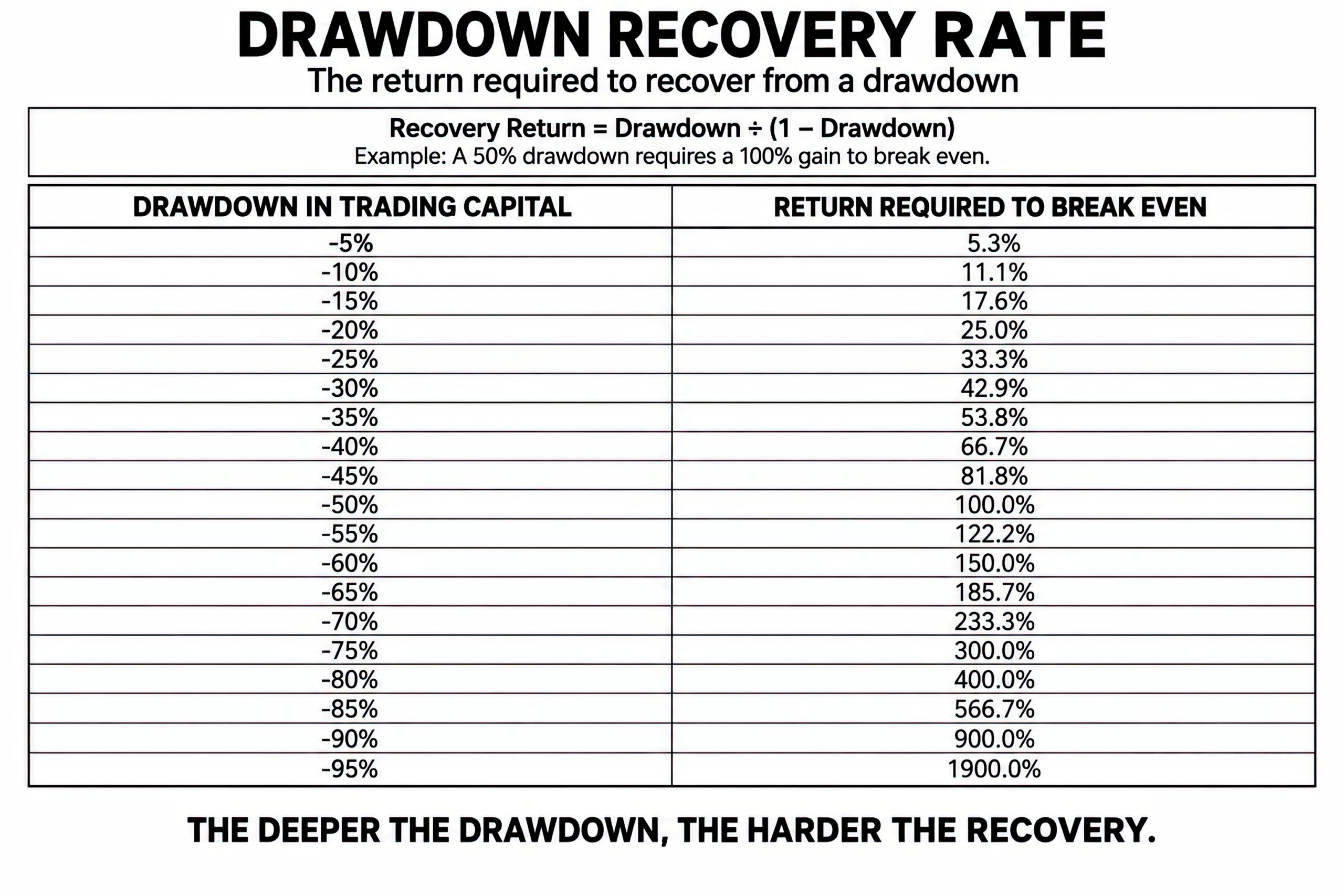
Borrowed money makes that problem worse. A decline you could have waited out turns into a forced sale when the lender wants to be paid.
Conclusion
Munger’s methods were simple to describe and hard to follow. He bought great businesses at fair prices, put serious money into his best ideas, and then left them alone for years.
He also stayed honest about what he didn’t know and spent as much time thinking about failure as he did about success. Anyone willing to copy that patience can use the same five strategies to give compounding the time it needs to multiply their wealth.